
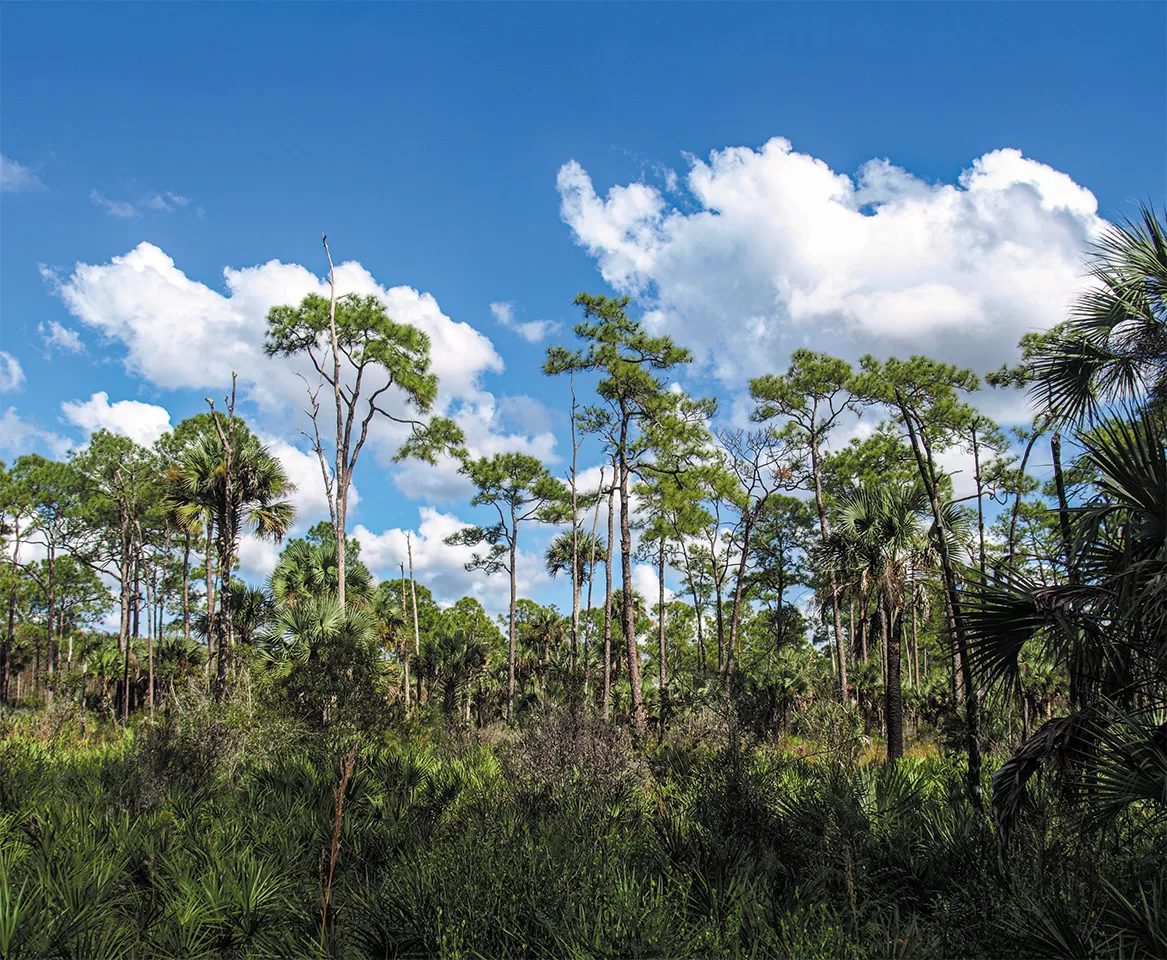
Explore the natural side of the Sunshine State at Corkscrew Swamp Sanctuary, a biologically diverse Audubon property with the largest stand of old-growth bald cypress trees on Earth.
By Josephine Matyas, F468364
March 2023
On a warm, sun-splashed winter day, I stood on the boardwalk at Audubon’s Corkscrew Swamp Sanctuary near Naples, Florida, and listened as the volunteer naturalist waved his arms in the air and explained how — even this close to Fort Myers — the Gulf Coast is home to protected wetlands and untouched landscapes.
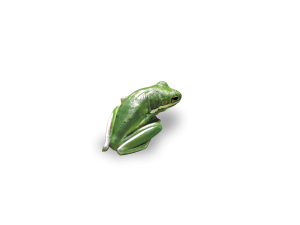
The sanctuary is home to the green tree frog.
Untouched landscapes in Florida? Audubon’s Corkscrew Swamp Sanctuary protects approximately 13,450 acres prized as a fine stand of subtropical, ancient bald cypress forest, where many of the soaring trees date back at least 600 years, predating the arrival of Columbus in the New World.
Corkscrew Swamp is a freshwater wetland fed solely by rainwater, covering thousands of acres of pristine cypress swamp. In this vast area, known as the Corkscrew Watershed, a broad sheet of water flows over the land, ranging from just a few inches to a yard deep.
According to our guide, this wetland is what south Florida looked like at one time: “The fresh water is the lifeblood of the Corkscrew Swamp and of the greater Everglades ecosystem. Over the past century, people have altered the natural flow of the water — to control flooding and to create land for development — but now we need to restore the natural system.”
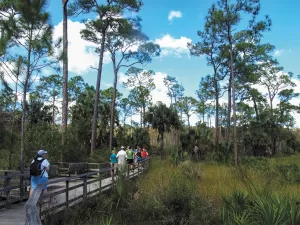
Visitors stroll along a raised boardwalk that crosses marsh, pine flats, and wet prairie.
Often misunderstood, swamps full of plants and insects were marked as areas rife with disease and decay and were quickly drained, stripped by clear-cut logging practices, paved over, and built upon, eventually squeezing out wildlife and their natural habitats. But in a state known for rampant development and construction, the swamp and trees at Corkscrew were saved when the National Audubon Society realized the forest needed protection, stepped in, and stopped the logging.
The sanctuary is a popular destination for birders and hikers, who walk along a 2.25-mile trail and raised boardwalk that twists and turns through marsh, pine flatwoods, and stretches of wet prairie. The tree branches are draped with resurrection ferns; the roots of the strangler fig wrap around host trees; and swamp plants like the waxy, aquatic alligator flag tumble over the railings.
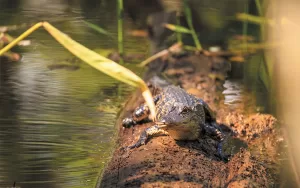
American alligators can be viewed at the Audubon Corkscrew Swamp Sanctuary.
Volunteer interpreters stroll the route, explaining to visitors how the wetlands act as filters for pollutants, reduce flood damage by soaking up water during heavy rains, stabilize the soils against erosion, and recharge groundwater during the dry months.
“In Florida, two extremes dominate the subtropical climate — wet summers and dry winters,” our guide explained. “The seasonal high and low water levels are a necessary part of the natural cycle, and each is vital for life in Corkscrew.”
Visitors load daypacks with sunscreen, water bottles, and binoculars. But according to the staff, they can leave the bug repellent at home, because Corkscrew defies all swamp logic: mosquitoes are rarely a problem.
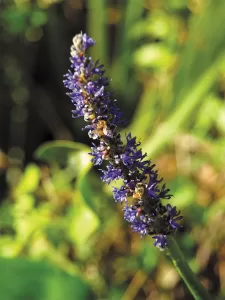
Pickerelweed thrives at the sanctuary.
“Your chance of running into a mosquito is greater in the parking lot than walking along the boardwalk through the swamp. We’re lucky to have a guppy-like fish called Gambusia holbrooki [mosquito fish] that feeds almost exclusively on mosquito larvae,” the guide explained.
The tiny mosquito-slurping fish get some help from the actual Corkscrew Watershed, a meandering river that flows toward the Gulf of Mexico. Although moving at a snail’s pace, the water in the swamp doesn’t become stagnant, and combined with the fish, this makes for a tranquil bug-free zone. The constantly moving water also is the reason Corkscrew does not have the dank smells usually associated with swamps.
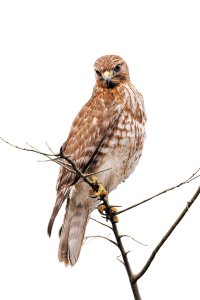
Red-shouldered hawks are seen year-round in Florida, frequenting Corkscrew Swamp’s cypress forests.
According to one estimate, 98 percent of all ancient forests in the United States have been logged, so Corkscrew is a rare habitat — a combination of large trees, fallen logs, and standing dead trees that provide wildlife with a variety of places to find food and shelter. In the soupy, subtropical climate, the trees are draped with moss, lichens, orchids, air plants, and dozens of types of feathery ferns. This protected landscape is home to the United States’ largest collection of gangly looking wood storks, whose nesting ground is the biggest tract of old-growth bald cypress forest in the world.
Corkscrew Swamp draws birds and birders by the thousands. In addition to the endangered wood stork, the wetlands are home to more than 200 avian species, including barred owls, painted buntings, red-shouldered hawks, white ibises, egrets, herons, and woodpeckers. Corkscrew is also a designated “Important Bird Area” and a major stop on the Great Florida Birding and Wildlife Trail.
Other wildlife abounds as well. The dangling leaves and roots of the watermelon-scented lettuce plants create a safe place for small fish and crayfish to hide or nest. Alligators often sun themselves on the riverbank, but they prefer the plankton-laden “lettuce lakes” — wide, shallow watering holes that are a favorite feeding site for wading birds, otters, and reptiles. The gators are efficient predators. They are one of the world’s largest reptiles but have a brain the size of a walnut — just enough to associate people with food if they’ve been fed by humans, but not smart enough to know the difference.
The raised boardwalk makes the perfect way to observe nature from a safe and respectful distance. And it’s the ideal way to appreciate what southwest Florida must have looked like before civilization took hold and transformed the landscape.
Further Info
Located northeast of Naples, Florida, the Corkscrew Swamp Sanctuary is open daily. Check the website for details on programs, dates, and reservations. The boardwalk is wheelchair and stroller accessible.
Corkscrew Swamp Sanctuary
375 Sanctuary Road W.
Naples, FL 34120
corkscrew.audubon.org
(239) 348-9151
Visit Florida
www.visitflorida.com
Work Camping At Corkscrew Swamp Sanctuary
Corkscrew hires RVers to work part-time and live at the sanctuary for seasonal assignments (especially in the winter). For more information, visit corkscrew.audubon.org/about/volunteering.