

Understanding the basics of this popular fuel and taking steps to make sure the system is maintained properly are essential for RVers whose vehicles make use of it.
By Chris Dougherty, F263059
June 2023
WARNING
Propane is a flammable gas. Care must be taken when working with propane, and safety is always first! If you suspect a problem or leak, evacuate the RV and turn off the gas at the source. Do not turn on any electrical equipment in the RV until it has been adequately ventilated. Keep your propane detector in good working order and replace it every five years or as required by the manufacturer. Seek a certified professional to do repairs and conduct annual inspections.
For more than 100 years, the RV lifestyle has been about bringing homelike conveniences and shelter along for the journey. This includes lighting, heating, refrigeration, and plumbing. As time has progressed and technology has advanced, RVs have incorporated many new ways of making life on the road more comfortable. One long-standing technology is propane. With it, we can heat our RVs and water, cook our meals, and operate some great outdoor appliances. Many RVs have propane-fueled generators, which power our modern electrical loads and charge our batteries.
Since so many of us own RVs with propane systems, it behooves us to know more about this energy source. Propane is one in a family of liquefied petroleum gases produced during the natural gas and petroleum refining processes. In the United States, the terms LP and propane are used interchangeably, but retailers generally market the product as “propane,” so we use that term most of the time in RV land.
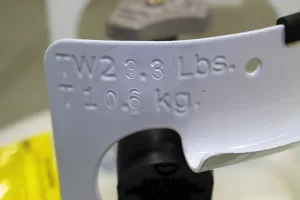
Data on DOT cylinder collars includes tare/empty weight.
Propane is an ideal fuel for RV and outdoor use. It is nonpolluting; clean burning; and in its natural state, it is colorless, odorless, and tasteless. An odorant called ethyl mercaptan is added for safety. This gives propane a pungent smell that some liken to rotten eggs and helps to provide warning of a leak. Propane gas is heavier than air. It is stored in a tank under pressure as a liquid. It changes from a liquid to a gas at minus 44 degrees Fahrenheit. The liquid is lighter than water and, therefore, would float on top of it were the conditions correct. Because the boiling point is so low compared to water, propane can freeze your skin on contact. In a liquid (pressurized) form, propane weighs approximately 4.2 pounds per gallon.
Most RV propane systems require very little in the way of regular maintenance, but for safety, there are some things that you, as an owner, should know and do. It should be noted, however, that for tasks beyond routine inspections and preventive maintenance, RV owners should seek an RV technician or other certified professional to work with propane systems. Unless they are certified themselves, owners should not perform repairs on a propane system. Also, an annual check of the entire propane system by a professional is strongly recommended.
In the RV world, propane is transported in two types of vessels: DOT/TC cylinders and ASME tanks, named for the regulations under which they are described, manufactured, and maintained. DOT stands for Department of Transportation, TC for Transport Canada, and ASME is the American Society of Mechanical Engineers.
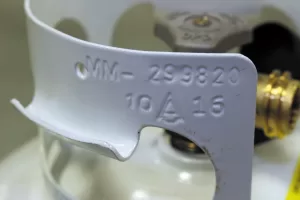
DOT cylinder info also contains the date of manufacture.
DOT/TC cylinders are found on most travel trailers and even some motorhomes, not to mention on our propane grills at home. These (typically vertical) cylinders have a valve on top that releases propane vapor and also allows for filling. Regulated by the Department of Transportation, cylinders range from tiny disposable appliance canisters to 200-gallon stationary models. RVs usually incorporate 20-pound or 30-pound, or sometimes 40-pound, cylinders. Using rounding, 20-pound cylinders carry 5 gallons of liquid propane; 30-pound cylinders hold about 7.5 gallons; and 40-pound cylinders hold approximately 10 gallons, all when filled to the 80 percent level.
DOT/TC cylinders must be secured for transport in an upright position. Cylinders in the United States must be recertified at 10 years from the date of manufacture, which is stamped on the cylinder’s collar, and every five years thereafter. In Canada, cylinders are regulated by Transport Canada (TC) and also must be recertified, or requalified, after 10 years.
ASME tanks are horizontal, built-in propane tanks designed for vehicle use. Most propane-equipped motorhomes utilize ASME tanks of various sizes and are filled to 80 percent of the listed gallon capacity. As regulated by the American Society of Mechanical Engineers, motorhome tanks do not have an expiration date, and therefore do not require recertification.
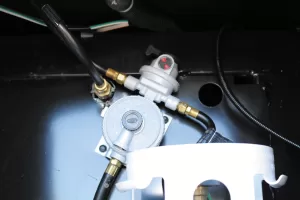
An automatic changeover regulator switches to a second cylinder when the first becomes empty.
A regular visual inspection of the system should be done at the beginning of each camping season and whenever the propane cylinders/tank are filled. Start with checking the tank or cylinders for damage or other issues, such as rust, dents, cracks, or peeling paint. Rust and paint can be repaired easily if caught early. Severely rusted tanks should be inspected by a professional, however, as should tanks or cylinders that have physical damage. A product such as Rust-Oleum works well for recoating rusty areas; just be sure to use a similar color paint. LP tank paint is available as a stand-alone product. Federal and state regulations, as well as the National Fire Protection Association, stipulate that light-colored paint be used, because it reflects heat from the sun. So, color options are silver, light gray, and white.
For RV appliance use, propane is reduced from vessel pressure to 11 inches of water column, which can be verified using an instrument called a manometer. Limiting the gas pressure allows for safe operation of appliances. Connections made directly to propane containers, and any pipe or hose between that connection and the regulator, is high pressure. This pressure, which is generally over 100 psi for propane, varies based on container fill level, temperature, and altitude. After the regulator, the pressure is reduced to 11 inches of water column, so the piping after the regulator is considered low pressure.
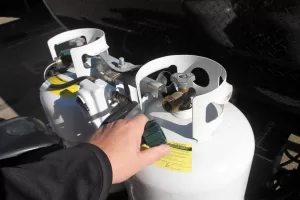
Cylinders usually connect to a regulator via a pigtail.
Inspect the high-pressure connections at the cylinders for any sign of damage, such as cracks. Damaged pigtails — the connection between the propane tank and the regulator — should be replaced. Make sure the regulator operates properly by switching between cylinders if so equipped. An annual manometer test by a certified professional is recommended. Examine the rest of the hoses and connections for any signs of damage or decay, and have repairs done as needed. Some animals enjoy chewing on rubber gas lines, which can cause big problems.
Tanks, cylinders, and mounts or cabinets should be kept clean, painted, and rust-free. Keep an eye on your cylinders’ dates; as noted, they require reinspection or replacement 10 years from the date of manufacture. A recent check in New England found no companies willing to recertify propane cylinders, so don’t be surprised if a replacement is your only option.
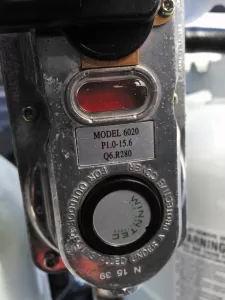
When an automatic changeover regulator switches from an empty to full container, the indicator turns red.
TROUBLESHOOTING TIPS
When a propane system malfunctions, it’s usually the result of a regulator problem or a leak somewhere in the system. These days, it’s rarely because of vessel overfilling, as modern cylinders and tanks have an overfilling prevention device, or OPD filling valve, which didn’t exist in the old days.
PROPANE ODOR
If you smell propane, the source of the leak must be found. You’ll want to check inside and outside the RV.
Inside: Quickly check to make sure all valves on the range or other propane-fueled appliances are closed. If the propane detector is also sounding, open the doors, exit the vehicle, and close the container valve(s). Once the odor is gone and the alarm stops sounding, the gas can be turned back on to check for leaks. A leak detector solution can be used to find a leak, but if you’re not comfortable with this, call a certified RV technician. Electronic propane leak detectors exist, but consumer-grade versions may not be accurate. A commercial detector is preferable. It is important to check all lines and connections, even those that are difficult to reach or identify. This could be another reason to seek help from a professional.
Outside: Check around the unit to see where the smell is coming from. If it is a significant leak (you can hear the hissing), close the supply valves and have the leak repaired by a professional. If the odor is slight, start checking around the system. A leak detector likely will be required to find a tiny leak. Once it’s located, shut off the gas and have the leak repaired. Be sure to check around the cylinders/tank for leaking connections or a failed regulator. Propane regulators that fail internally usually vent gas. If the regulator has failed, it will need to be replaced. (Tech hint: Technicians should always use gas-rated thread-seal tape when replacing pipe thread connections on propane systems.)
APPLIANCE MALFUNCTION?
When an appliance doesn’t work correctly, and the propane side of the system is suspected as the cause, some troubleshooting tips can help. Of course, if a leak is suspected, you’ll want to instead seek professional help.
First, always verify that the propane is on and that the tank/cylinders have gas. If the system has been off for a long time, air in the system will need to be purged before an appliance can light. The farther from the propane source the device is, the longer it will take to purge the air. Also, the lower the gas flow rate, the longer it will take.
When you light a burner on the range during normal operation, it should be a nice blue color, with no, or almost no, yellow flame at the top. The flame pattern should be steady. If the flame is too small, mostly yellow, or fluctuates in size and shape, there may be an issue with the regulator, air mixture, or contamination of the propane.
If the burner flame is good, try turning on the furnace. If the flame becomes smaller or inverts into the burner box when the furnace ignites, a regulator or ventilation issue may require a diagnosis. Turn the appliances and the propane system off immediately and seek professional help. Also, abnormal noises, like popping sounds or backfires, should be treated as malfunctions, the system shut down, and a professional technician contacted.
Remember that propane loses significant BTU in frigid weather, and regulators can freeze up. Regulators should always have a cover, and the vent on two-stage regulators must point straight down, or within 45 degrees of straight down.
WHEN TO FIND A PROFESSIONAL
As mentioned above, propane can be hazardous, especially if not handled properly. If you’re not comfortable working with propane and don’t have the proper training or certification, maintenance and repairs should be left to a professional. Certified RV technicians are trained to handle most RV propane issues, as are most propane gas companies with mobile service capabilities.
Regardless of their configuration, the propane systems in our RVs allow us great freedom and the ease of heating and . . . well . . . cooking with gas! Enjoy the journey!