
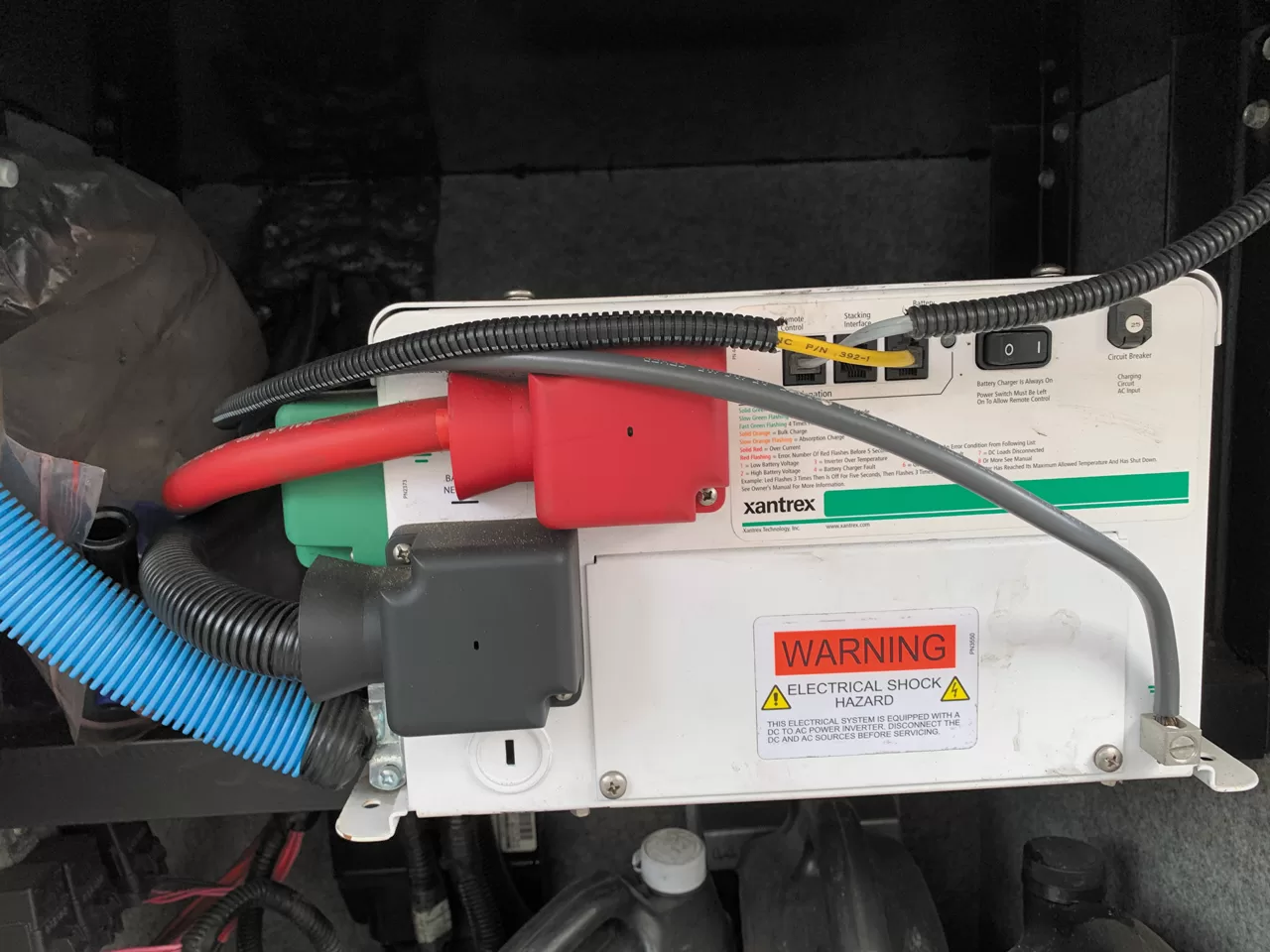
Several sources of 120-volt alternating current exist, and it’s beneficial for RV owners to have a basic understanding of how this system functions.
By Steve Froese, F276276
June 2023
Last month’s column covered RV 12-volt direct current (DC) electrical systems, so picking up from there, we will move on to 120-volt alternating current (AC) systems. The 120-volt system provides power for appliances such as rooftop (or basement) air conditioners, AC receptacles, water heaters and refrigerators (if so equipped), microwave and convection ovens, entertainment systems, fireplaces, and the like. The information that follows is intended as a basic primer and will not focus on maintenance or troubleshooting.
Unlike 12-volt DC, very little difference exists between the 120-volt system in a travel trailer versus a motorhome. It always starts with the shore power cord, which conveys AC power from the RV park power pedestal into the RV for distribution. The RV may be equipped with a generator and/or inverter(s) for alternate sources of AC power.
If the RV utilizes a generator, a transfer switch likely will be involved. In some cases, the RV owner must plug the shore power cord into a generator receptacle, but that is uncommon in modern RVs. The transfer switch allows for automatic changeover between generator output and shore power, while preventing both power sources from feeding the RV at the same time. The latter could be catastrophic, because of the likelihood of the two power sources being out of phase with each other, but such detail is outside the scope of this article. Suffice it to say that multiple sources of AC voltage should not feed an RV at the same time. Whether electricity is being produced by a generator or delivered through shore power, the transfer switch will ensure that only a single source of current is provided to the RV for distribution.
While variation does exist in how RVs are wired, the next component in the AC system usually will be either a power converter or an inverter/charger. An inverter/charger has slightly more complex wiring on the AC side, so let’s first discuss converters.
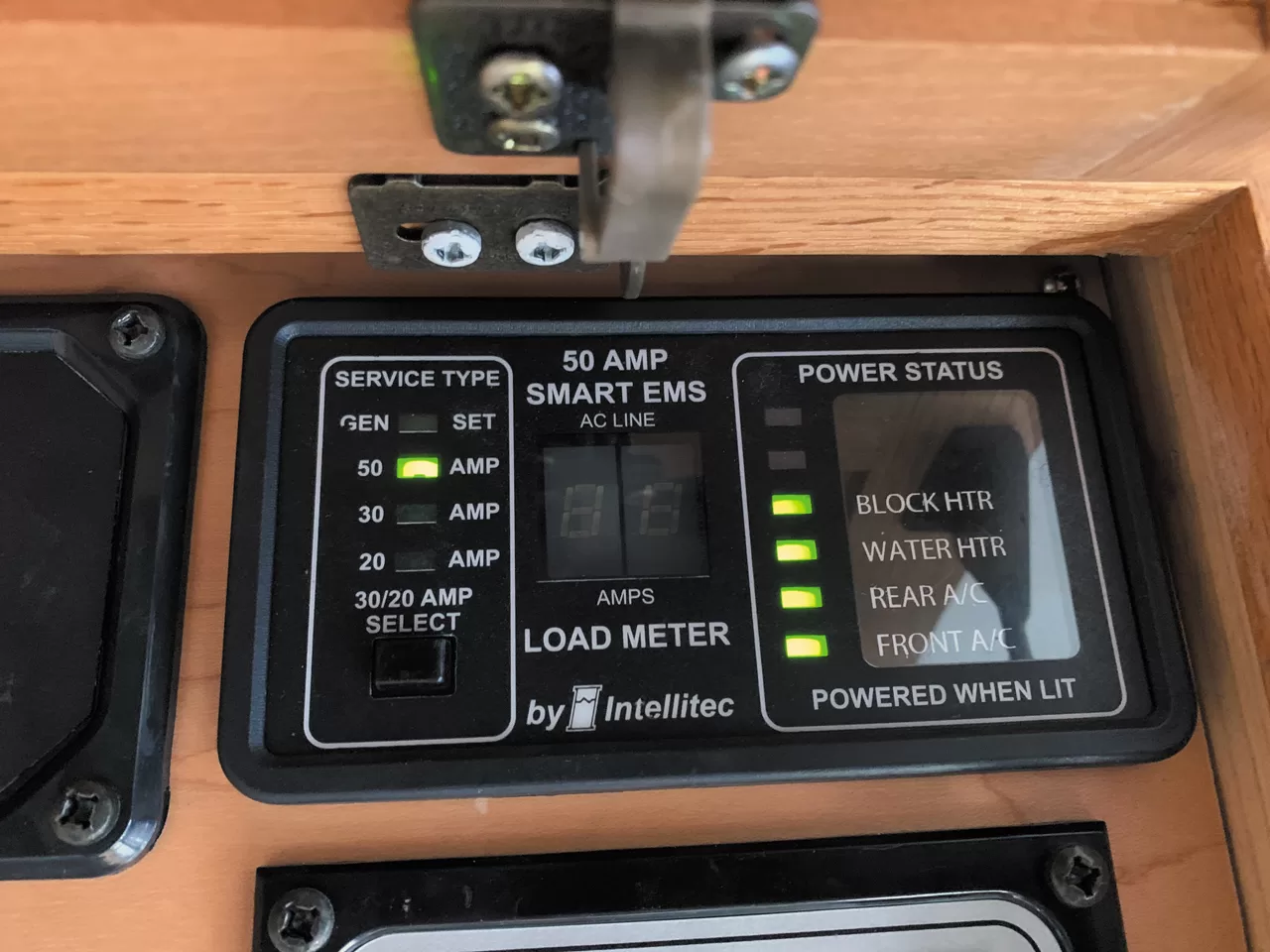
Some RVs have an energy management system, which automatically and temporarily shuts down branch circuits in case of an overcurrent situation.
As mentioned last month, a converter serves several functions in an RV. It converts 120-volt AC to 12-volt DC to power low-voltage DC loads; provides battery charging; and distributes both 12-volt and 120-volt current to the various branch circuits in the RV. I covered the 12-volt functions last month, so let’s examine the 120-volt features.
The incoming 120-volt power to the converter is distributed to the various AC branch circuits through breakers arranged in a panel, as well as rectified into 12-volt DC for battery charging and distribution to the low-voltage loads. Some converters have all features combined into a single unit, including 12-volt fuses and AC circuit breakers. Others separate the converter section and the fuse/breaker panels. It is a good idea to become familiar with your converter, if your RV has one, so you know where the fuses, breakers, and converter sections are located.
Most separate converters are basically power supplies plugged into a 120-volt receptacle in a concealed compartment of the RV, with the 12-volt wiring coming out the other side. Troubleshooting these converter modules is fairly easy, since a loss of 12-volt power generally can be attributed to loss of power at the 120-volt receptacle; a blown 12-volt fuse on the output side; or a failed converter module, requiring a simple swap-out replacement of the module.
Single-unit converters are a little more difficult, but a failure of the converter section generally can be remedied by replacing the “bottom end” of the converter. This is so named because a single-unit converter consists of the fuses and circuit breakers at the top and the converter module at the bottom. It is always best to seek professional assistance with troubleshooting AC or DC power in an RV beyond the basics of checking AC input, DC battery voltage, or fuses and circuit breakers.
If your RV has an inverter/charger instead of a converter, it simply operates in reverse to charge the batteries. In other words, an inverter in “operating” mode takes power from the battery bank and inverts it to 120-volt AC to power some receptacles and appliances. In “charge” mode, it takes power from the generator or shore cord and converts it to 12-volt DC to charge the batteries, which in turn provide low-voltage power throughout the RV.
Most RVs equipped with factory-installed inverter/chargers have two breaker panels: one for the shore power/generator loads and another for inverter loads that are live when only battery power is available (when the inverter is operating with no shore power or generator). This means the main breaker panel will be fed directly from the shore power cord or generator (by way of the transfer switch) and allow for branch circuit power distribution, which includes feeding the inverter subpanel. Including the subpanel, there will be circuits for all 120-volt-AC loads, among them all receptacles, air conditioners, etc. When no shore power or generator is available, only the inverter subpanel loads will be energized, providing power to a select number of branch circuits. Circuits that generally are not included in inverter loads are air conditioners, refrigerators, washer-dryers, and other high-current-draw loads. Many modern RVs incorporate very large battery banks and multiple inverters to provide AC power to at least some of these larger loads, especially residential refrigerators.
Again, it is outside the scope of this article to describe the theory of operation or schematics surrounding the inverter/charger subpanel, so seek professional guidance if you believe you are experiencing issues with the 120-volt system.
In terms of the main 120-volt breaker panel, the output from the transfer switch — whether the input is shore power or generator — is connected to the main circuit breaker, which feeds the “hot” rail. The hot rail in turn supplies power to each branch circuit through the circuit breakers. In the case of a 30-amp RV, a single hot rail with a capacity of 30 amps feeds the branch circuits. This means the total current draw in the RV can’t exceed 30 amps at a time or the main RV breaker or park pedestal breaker will trip. NEVER attempt to open the 120-volt breaker box or access any of the 120-volt wiring before completely de-energizing all high-voltage sources, including disconnecting the shore cord and turning off the generator and inverter. Do not attempt to troubleshoot, or alter the wiring of, 120-volt-AC systems without appropriate electrical knowledge. Resist the temptation to enlist the assistance of an electrician unless they are familiar with RVs, as 30-amp RV systems differ from residential and industrial 30-amp wiring.
In the case of RVs equipped with 50-amp service, the total current available is actually 100 amps, as the system has two “legs” of 50 amps each. In this configuration, there are two hot wires, each carrying 120 volts (to neutral), and each capable of handling 50 amps of current. Each of these wires is fed to separate 50-amp main circuit breakers (the reason 50-amp RVs have two main breakers) that supply power to separate hot rails. The individual branch circuit breakers can be connected to either one (but not both) of these hot rails, allowing for more total power. For instance, in an RV with twin rooftop air conditioners, one of the air-conditioning units will be wired to one hot rail, while the other will be connected to the other hot rail. Each hot rail has a capacity of 50 amps, so these RVs generally do not experience circuit overload, although it is possible. While 240-volt AC is available by bussing both hot rails together, this configuration is rarely used in an RV, as it may be in a residence or business.
Some RVs also incorporate energy management systems (EMS), which automatically and temporarily shut down branch circuits in the case of overcurrent conditions. They do so in reverse priority order; high-priority loads such as air conditioners are shut down last. The power is restored to the controlled loads once the current demand drops. An EMS is especially useful in preventing circuit tripping in 30-amp situations.
The specific AC configuration of your RV may differ from the general makeup outlined here, but the theory of operation is the same. As indicated, this article is not meant as a troubleshooting aid, but only to provide basic information as to how the 120-volt-AC system in your RV functions. Feel free to contact me via email — techtalk@fmca.com — should you have specific questions about your RV.
Send your troubleshooting questions to Steve Froese at techtalk@fmca.com. The volume of correspondence may preclude personal replies. Not all responses will apply in every instance. Some situations may require a visual inspection and hands-on testing. If you choose to follow any procedures outlined in this column, first satisfy yourself that neither personal nor product safety will be jeopardized. If you feel uncomfortable about a procedure, stop and make an appointment with an RV service facility.
You may also want to consult the FMCA Forums (https://community.fmca.com) to see whether your question has already been addressed or, if not, to post it.