
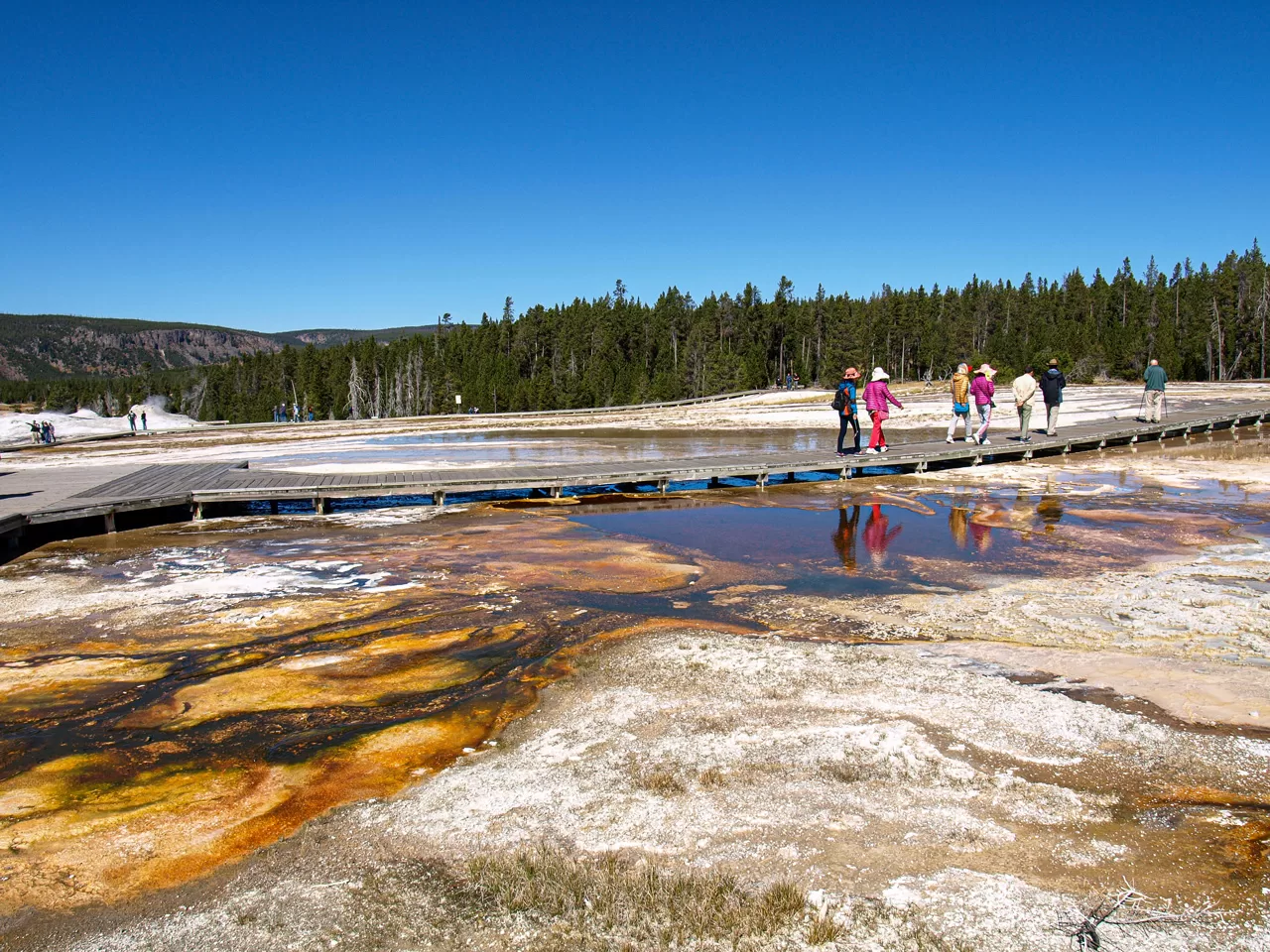
America’s first national park is a true gem located on top of a volcanic hot spot. From dense pine forests to boiling-hot geysers, visitors have plenty to see.
By Josephine Matyas, F468364
July 2023
During spring, summer, and fall in Yellowstone National Park, people visit to glimpse a herd of bison, mighty elk, bighorn sheep, or a mama bear with her cubs. Yellowstone should not, by any measure, be a quick hit-and-run experience. The park’s main roadways are laid out in a figure eight, with interesting spur roads off to the sides, and it takes several days to properly explore them. By breakfast time, there may already be heavy traffic and bumper-to-bumper traffic jams, especially if slow-moving bison decide to meander across the asphalt and create an infamous “bison jam.”
When it comes to travel planning in our Type B motorhome, I am the kind of person who works best with a boatload of information, highlighted maps, and a schedule for how the day should unfold. In Yellowstone, I tossed the schedule out the window and embraced flexibility, with one exception: We set a predawn alarm on day one, left the campsite, and stopped along the West Thumb of Yellowstone Lake, mesmerized by the outlines of elk silhouetted by the orange sunrise peeking over the Absaroka Range. It turns out that “the early bird gets the worm” could be the very best piece of Yellowstone advice.
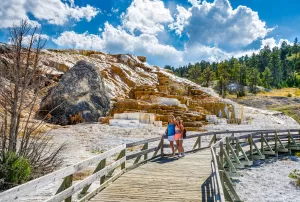
Explore Mammoth Hot Springs and stroll along the boardwalks above the hydrothermal features.
Here’s a case in point. Yellowstone is renowned on two different fronts: the incredible diversity and number of wildlife, as well as the more than 10,000 geothermal geysers, hot springs, fumaroles, and mudpots scattered across the caldera — the ancient volcanic crater that stretches 45 miles from rim to rim. When the roadways, trails, boardwalks, and lookouts become packed, it can distract from the magic of the experience. However, you can maximize the magic. Just set the alarm and get up early. In many cases, it will feel like you have the place to yourself.
WYOMING’S WILD SIDE
We’ve visited Yellowstone around the calendar. In autumn, the frisky elk are rutting, and smart humans observe from a safe distance, especially taking care not to get between a bull and his female harem. It’s common to see elk on the lawn at places such as Mammoth Hot Springs, while frazzled park rangers guide foot traffic well around a protective bull elk and his cows.
The greater Yellowstone ecosystem is home to 67 species of mammals, and many visitors long to spy on the “big eight”: grizzly bears, black bears, bighorn sheep, bison, elk, moose, pronghorns, and wolves. The elk, pronghorn, and bison are prolific (factor in inevitable bison jams when planning travel times). Bears, moose, and wolves can be more elusive. Park regulations explicitly state that visitors should keep a safe distance — 100 yards for bears and wolves; 25 yards for bison, elk, and all other wildlife. Find a pull-out so you don’t block traffic, and then dig out binoculars or a camera lens. Do not, under any conditions, attempt a selfie with wildlife.
The best stretch for viewing herds of bison is the Northern Range, a hilly and less forested part of the park that is also a prime wolf and bear area (grizzlies prefer open spaces). In that area, the Hayden Valley — along Grand Loop Road — and the Lamar Valley are sure bets for bison, which often clog the roadways.
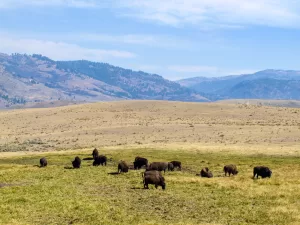
In the park’s northeastern corner, Lamar Valley, or “America’s Serengeti,” is home to bison, pronghorns, wolves, bears, etc.
Before pioneers settled in the West, bison roamed these sprawling valley grasslands. Before the mid-1800s, 30 to 60 million bison grazed across the West and were a vital source of food as well as hides for clothing and shelter. By 1900, a Yellowstone herd of just two dozen bison had escaped the relentless slaughter by poachers and hunters. Through protective management, the free-ranging herd has grown into the thousands. The park is home to the wildest bison population in the lower 48, and in this sprawling territory there are no fences to hem them in, so you never know what is just around the corner.
FIND THE SHOW BUBBLING UP
It’s sobering to realize that the heart of Yellowstone, the world’s first national park, established in 1872, is largely set inside a gargantuan volcanic crater — the largest supervolcano on the planet — and one that geologists estimate to have erupted about 640,000 years ago.
Yellowstone’s 2.2 million acres are largely blanketed by forests of lodgepole pine bordered by expansive grasslands and punctuated by the world’s largest concentration of hydrothermal geysers, hot springs, steam vents, and mudpots. Visitors view scalding water that shoots into the air, otherworldly colored hot pools, and dramatic columns of hissing steam.
Think of Yellowstone as a conduit to the heart of the planet. A few miles under the surface, chambers of superheated molten rock boil water that has seeped down through cracks in the Earth’s crust. The red-hot water rises to the surface, erupting in jaw-dropping displays of bubbling and hissing steam, waterspouts, and mud that burps from forces unseen. The sheer concentration and intensity of these geothermal features is pure geologic magic. About half of the world’s geysers lie within the park’s boundaries in the northwest corner of Wyoming.
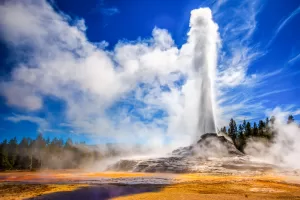
Castle Geyser is thousands of years old and erupts about every 14 hours, with water frequently reaching 75 feet high.
Getting onto the driving loops and hiking trails as the sun rises is also key to beating throngs of visitors to the geothermal sights. The world-famous Old Faithful geyser is a mandatory stop for many visitors and probably is the most crowded geothermal location in the park. But we found that significantly fewer people ventured onto the excellent trails and boardwalks behind the famous geyser. It was along these scenic boardwalks where things really got interesting. And as the park has become even busier in a world affected by the COVID-19 pandemic, the “up and out early” rule applies even more so.
More than 900 miles of hiking trails traverse the park, and the nonnegotiable (and smart) rule is to not step off the marked trails and boardwalks. In many spots, the thin ground can break easily, dropping into pools of scalding water. There are literally hundreds of options for walking, gawking, and marveling while staying safe.
We easily spent a half-day exploring the spiderweb of walkways immediately behind Old Faithful. There, things became less crowded and showier at geysers such as Grand, Castle, and Beehive, and at the electric-blue hot pools and pink mudpots that line the boardwalk. There might be a thousand gawkers waiting for Old Faithful, which erupts roughly 20 times daily and puts on a dazzling five-minute show, but only a dozen people at lesser-known geysers along the hiking trails. This part of the park, known as Upper Geyser Basin, boasts over 150 geysers and approximately one-fifth of the world’s total. There is much to explore in the park.
Not far to the north of Upper Geyser, the Firehole River meanders through Midway Geyser Basin. Writer Rudyard Kipling nicknamed this spot “Hell’s Half Acre,” and it’s where we found Yellowstone’s largest hot spring, Grand Prismatic Spring, which is roughly the length of a football field.
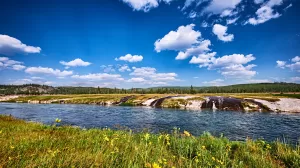
Firehole River flows through geyser basins and over three major waterfalls: Kepler Cascades, Firehole Falls, and the Cascades of the Firehole.
A short drive farther up the road, Artists Paintpots’ many geysers filled the air like a mammoth Turkish steam bath, with terraces of gurgling, bubbling, grayish clay mudpots. Mudpots form when hot springs combine with sulfuric acid to dissolve surrounding rock into boiling mud and clay. We viewed more mudpots and active geysers at Porcelain Basin Boardwalk in the Norris Geyser Basin, as well as rainbow-colored thermal pools that are home to organisms able to thrive in extremely hot, acidic environments.
On the eastern part of the lower loop, my favorite spot was the Mud Volcano Interpretive Trail. It’s just past Fishing Bridge at the top of Yellowstone Lake, and it’s an easy loop overlooking dark, oozing globs of mud with names such as Black Dragon’s Caldron, Sizzling Basin, and Dragon’s Mouth. It’s just a few miles from the RV campground hub near Lake Village, but with an early-morning start, we had the place to ourselves.
EXPLORING YELLOWSTONE 101
It’s this haunting, magnetic landscape that makes Yellowstone National Park an irresistible place for an RV journey. The well-developed road system is easy to navigate, with dozens of scenic viewpoints and pullouts, services at several visitor centers, campgrounds, and shops stocked with essentials.
The southern loop of the figure eight sits in the caldera, which lines the side of the road in some spots, and it is the main route for experiencing the park’s attention-grabbing geothermal features. The smaller road loop to the north encompasses a mix of forests and the peaks of the Washburn Range, spilling down onto the expansive grasslands of the Lamar and Hayden valleys, the hot spots for wildlife viewing.
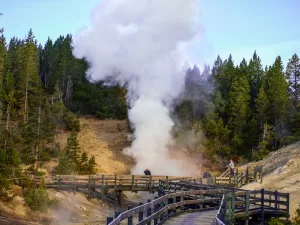
Dragon’s Mouth Spring is a quick trip down the boardwalk from the Mud Volcano.
Information gleaned at the 10 visitor centers and information stations helps RVers choose the best routes for the size of their unit. Some routes are narrow, twisty, and more challenging to navigate for large vehicles. Summers are peak demand time, and the park’s campgrounds are usually fully booked. The spring and fall shoulder seasons are less crowded, with fewer vehicles on the road, but reservations are still advised. Snow is less likely in the summer but can happen at any time — on an early September morning, we woke early to a blanket of white and were grateful to be in a warm and dry RV.
ROAD CONDITIONS AND CLOSURES
Last year, Yellowstone was impacted by flood damage to its infrastructure, including roadways. Updates regarding this can be found on the park website: www.nps.gov/yell. Click on “Alerts,” and then click “Road Status & Closures” under “Park Roads” for seasonal road opening/closing dates and current construction projects.
Some visitors might associate the Yellowstone caldera with a world of action — one that needs to be rushed through to see it all. But the opposite is true. This singular landscape deserves a slow, mindful approach . . . just as long as you remember to pack the alarm clock.
MORE INFO
Visit www.nps.gov/yell for general park information.
A single-vehicle seven-day Yellowstone Entrance Pass is $35. An America the Beautiful National Park Pass gives unlimited entry to all National Park System sites at $80 per year. The annual Senior Pass costs $20; a lifetime Senior Pass costs $80.
Of Yellowstone’s 12 campgrounds, only Fishing Bridge RV Park has full hookups. Generators are allowed at several of the campgrounds. Visit www.yellowstonenationalparklodges.com or www.nps.gov/yell/planyourvisit/campgrounds.htm for info on all park campgrounds.
All campgrounds have large metal bear-proof boxes for food storage, and cans of bear spray are sold in the park’s general stores. Bear 101 handouts cover the basics: Watch for scat or tracks, make noise when hiking, travel in groups, and don’t run if you come face-to-face with a bear.
If you are entering Wyoming from the east, make time to stop in Cody at the Buffalo Bill Center of the West, which is home to the excellent Draper Natural History Museum, a primer to the geology and wildlife of the Yellowstone Basin. More information can be found at www.centerofthewest.org.
If entering from the south, you will come through spectacular Grand Teton National Park, which is a short drive from Yellowstone. It is worth allotting time to visit both parks. Visit www.nps.gov/grte/index.htm for more details.
Visitors may think Yellowstone National Park lies entirely within northwest Wyoming, but note that tiny sections also extend into Montana and Idaho.