
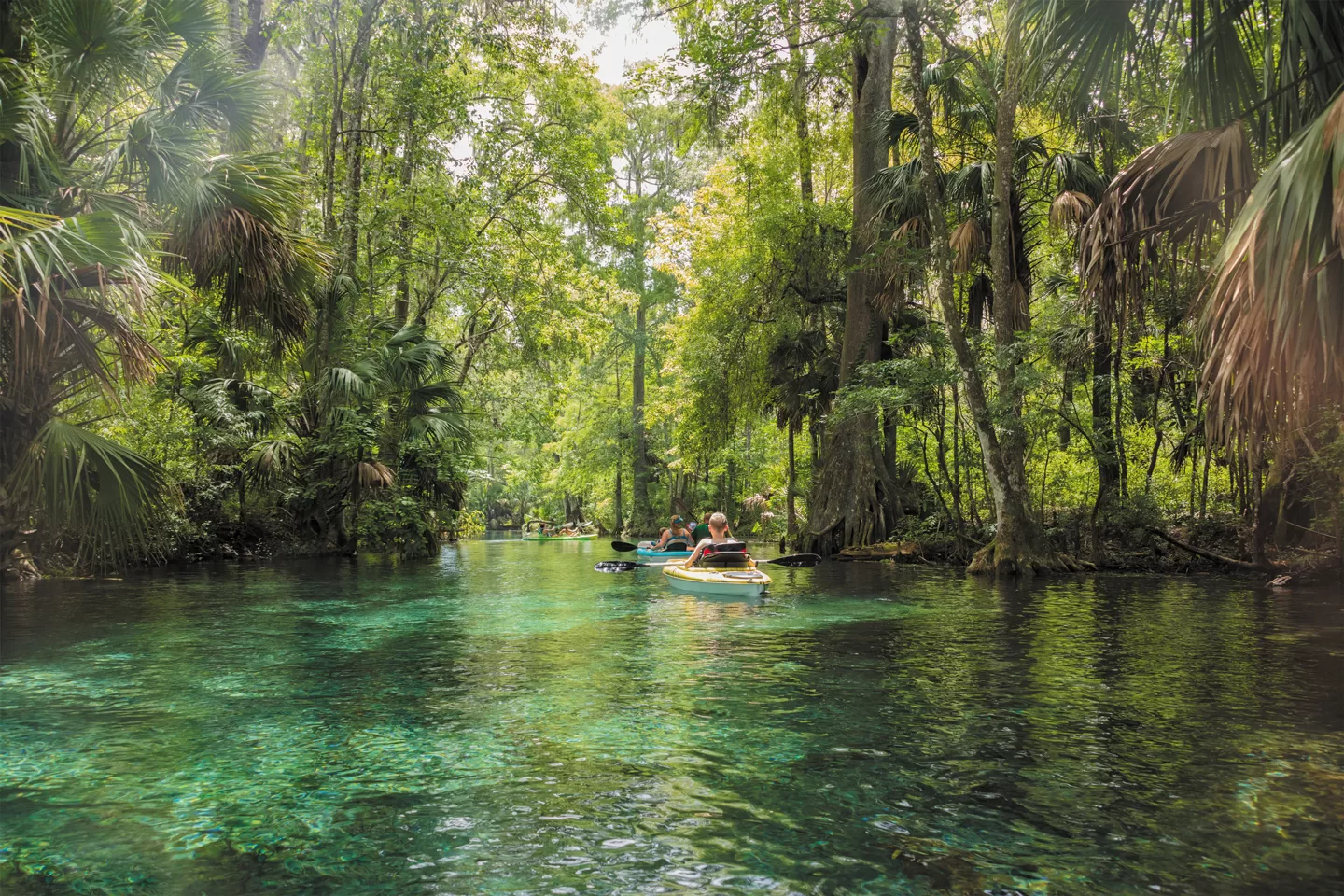
Central Florida is full of fun activities, but often the best places to visit were created by nature.
By Kathleen Walls, F522187
August 2023
Nature lovers visiting central Florida may want to skip the man-made theme parks and explore a natural attraction: Ocala National Forest. Encompassing about 387,000 acres, Ocala is the southernmost national forest in the continental United States. With the mysterious waters of the Ocklawaha River on the west and the powerful St. Johns River on the east, it offers many opportunities for swimming and kayaking. When you are seeking a bit more civilization, venture west and enjoy everything the city of Ocala has to offer.
THE FOREST AND ITS SPRINGS
You can camp in the forest or outside it. The little community of Salt Springs lies at the northern tip of the forest on State Road 19. Salt Springs Recreation Area is the largest campground in the forest, with 106 sites. Sites cost around $65, but there are add-on fees. If you have a National Park and Federal Recreation Lands Pass, you get half price (visit store.usgs.gov for info about the various passes available). It’s the only Ocala National Forest campground with full hookups. It also has a swimming area.
Consider visiting Juniper Springs for its campground and hiking trails.
Across the highway, Salt Springs mall has shops, dining options, and even a post office. Directly behind the mall is Elite Resorts, which also has full-hookup campsites, along with pools, a spa, a beach, and lotsof other activities, as well as a flea market every Saturday.
Salt Springs Grocery is one of the best-kept secrets in the forest. It’s just a few yards from Salt Springs Campground on State Road 19 and looks like a small gas station. Locals know that they have fresh produce, seemingly any grocery needs, and some of the best chicken tenders anywhere.
Heading deeper into the forest, visit Alexander Springs Recreation Area. If you’re looking for more primitive camping, you’ll find it here. Located in wooded flatlands, Alexander Springs discharges 80 million gallons of crystal-clear water at a constant 72 degrees. Because it is so clear, the spring is perfect for swimming, scuba diving, fishing, and canoeing. Its campground contains 67 primitive sites that accommodate RVs up to 35 feet — all wooded and private — along with restrooms, hot showers, a dump station, a snack bar, and canoe rentals. The standard non-electric sites are $34. Access to the day-use area is available for a fee. Locals avoid the paid area and enjoy swimming in the springs at the bridge on County Road 445 just east of the area’s entrance. You can launch a canoe or kayak there and paddle into the springs.
Another popular camping spot is located at Juniper Springs Recreation Area. Like Alexander Springs, it’s set in wooded flatlands, with a spring and a swift-flowing creek that has a canoe run. Its campground has 79 sites, restrooms, hot showers, a snack bar, a boat ramp limited to canoes, and canoe rentals.
There are hidden treasures in the forest from Hopkins Prairie to Lake Eaton, the latter with its sinkhole. The roads are mostly dirt but well-maintained, so you don’t need a four-wheel-drive vehicle. Hopkins Prairie is a primitive campground great for wildlife viewing, but be aware it’s a good way off the main road. If you visit, there’s another locals’ spot for swimming called Shady Lake on the way. The turnoff from State Road 19 to Forest Road 86 has a sign that says “Hopkins Prairie,” but the turnoff was not marked the last time I went, so map it out well if you go.
You’ll see many people swimming in the springs and rivers.
Need more information about Ocala National Forest while you’re there? There are three visitors centers. One is near Pittman on State Road 19 close to the southern end of the forest. The Ocklawaha Visitors Center is off of State Road 40, just inside the western edge of the for-est. A third in Salt Springs is in the northern part of the forest and adjacent to Encore RV Resort.
SILVER SPRINGS STATE PARK
The National Park Service brags about Florida’s bears, alligators, gopher tortoises, and wild birds, but it rarely mentions the rhesus macaque monkeys. In 1938, tour boat operator Colonel Tooey ran a jungle cruise boat ride at Silver Springs when it was a privately owned park. He brought rhesus macaques, which are native to Asia, to liven up a nearby island. The park was already promoting Ross Allen, a herpetologist and reptile wrangler, so the idea wasn’t too far-fetched. It was assumed the monkeys couldn’t swim — but they could, and they swam off the island almost as soon as they arrived. Most of the monkeys remained around the banks of the Silver River, and some headed east to where the Silver River flows into the Ocklawaha River in the forest. Beginning in 1984, the Florida Game and Freshwater Fish Commission decided they were exotic and needed to go. The monkeys were trapped and removed to control the population growth.
Just west of the forest on State Road 40 is the tiny town of Silver Springs, home to Silver Springs State Park, complete with full-hookup campsites and glass-bottomed boats. The boat rides may be your best chance to spot one of the remaining rhesus macaque monkeys. I can pretty much guarantee you will see lots of wading birds, both in the forest and at Silver Springs. You’ll also view countless fish, turtles, alligators, and other underwater creatures during the boat ride. Manatees are commonly seen in the winter.
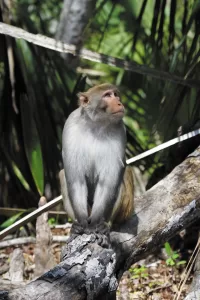
Rhesus macaque monkeys have been roaming Florida since the 1930s.
Captain Bill, our guide on the boat ride, told us he sees the monkeys on the longer weekend boat cruises. His advice if you see them: “Do not approach. They will not attack. They will not bite you. They will throw poop at you.”
The tour takes you to a dock where the “Sea Hunt” television show was filmed. Creature from the Black Lagoon and multiple Tarzan movies were filmed there as well. The park also includes trails, a garden, a statue of Seminole chief Osceola, and an amphitheater that offers big-name entertainment several times a year. You can also rent a kayak or canoe and explore the spring for yourself or on a guided tour.
The park is divided into two sections: the front, with the boat tours and gardens; and the back, with camping, a great museum, and Cracker Village, a replica of a 19th-century pioneer settlement. Trails wind through both sections. The two loops offer 59 spacious campsites that can accommodate RVs up to 50 feet. Sites have water and 50-amp electric, along with a fire ring, a grill, and a picnic table. If you’re searching for the best bargain, this is my choice.
LOCAL HISTORY
The forest holds many other secrets, such as Ponceannah Cemetery, where Walt Disney’s grandparents are buried. Charles and Henrietta Call were Lake County pioneers in the late 1800s. Their graves are near the back of the cemetery, with a plaque describing the Disney connection. Ponceannah Cemetery is off County Road 42, about a mile from Clearwater Lake Campground, one of Ocala National Forest’s primitive facilities.
One of the United States’ most famous female gangsters, Kate “Ma” Barker, died in a gunfight in Ocklawaha. A number of old movies depict a machine-gun-toting mama; some documentaries tell a different story. Today the Bradford-Ma Barker House is located in Carney Island Recreation and Conservation Area in Ocklawaha. When I visited, I learned the facts were very different from the image the public has of Kate Barker. Looking at the bullet holes from FBI guns brings the story to life in a way no movie can — she was involved in one of the most famous shootouts in FBI history.
The Barker-Karpis gang committed a string of murders, robberies, and kidnappings across the country and had been in and out of prison since 1910. Kate, their mother, tried to protect and excuse her sons. In 1934, they hid out in Florida, but the FBI traced them there and located their hideout. In the meantime, most of the gang had left, leaving only Ma and her son Fred at the house. On January 16, 1935, the FBI surrounded the home and ordered them to surrender. Fred refused, and a gunfight ensued. After the shootout, J. Edgar Hoover realized that killing a 61-year-old widow might not look so good in the press. He issued statements calling Ma Barker “the most vicious, dangerous, and resourceful criminal brain of the last decade.” After other gang members were captured, including Alvin Karpis, probably the real mastermind behind the gang’s activities, the truth came out. They all said they sent Ma to the movies to keep her out of the way while crimes were being planned.
The house, built in 1930, was moved across Lake Weir to its present location. It contains most of the original furnishings from the time of the shootout.
Greg Wiley, who guided our tour, led us into a living room with a brick fireplace and natural wood floors and showed us pictures of the original owners as well as the Barker family. Each bedroom upstairs is refurbished as it was then. The men’s rooms contain simple furnishings. Pictures indicate that many cots were set up around the house to accommodate other gang members. Ma’s room is the nicest, decorated with a sleigh bed and Queen Anne-style furniture. A chair with bullet holes in its back sits near the window in the upstairs front bedroom where Fred and Ma were shot. Many of the original bullet holes remain in the house.
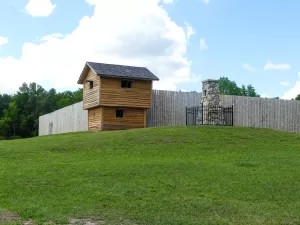
Fort King National Historic Landmark, west of Ocala National Forest, was built by the U.S. Army in 1827.
OTHER ATTRACTIONS
Can you imagine canyons in central Florida? Well, they’re there, but nature didn’t form them. The Canyons Zip Line and Adventure Park is a beautiful example of humans and Mother Earth uniting to recycle. Looking at the beautiful landscape, with its lakes, caves, horse trails, and one of the largest ziplines in the United States, you would never visualize this as a limestone mine at the turn of the 20th century.
When Traci and David Walker discovered this 94-acre quarry reclaimed by nature, it was love at first sight. They opened The Canyons in 2011. Nowhere else in Florida can you stand at the top of a canyon and look down on a sparkling blue lake 100 feet below.
You can zip three different routes, and you can even take a night zip. If you prefer more grounded fun, enjoy a horseback ride or a kayak trip along the waterways. To learn how the park’s transformation came about, take a trip on the Mine-N-Wine Wagon: a history tour combined with your choice of wine or chocolates on a wagon equipped with iPads that relate the history of each place where you stop. Remnants of the old mines are visible, including a train trestle, a rusted metal door from one of the mine’s buildings, and more. The area abounds in artifacts, some dating back to the Second Seminole War.
If you’re interested in more historical places to check out while you’re in Ocala, the Fort King Visitor Center and the Archaeological Resource Center are worth a visit. They’re open on Fridays and Saturdays from 10:00 a.m. to 5:00 p.m. The reconstructed fort showcases the struggle between settlers and Native Americans.
Visitors who venture to Ocala National Forest and the surrounding area will discover that central Florida holds a treasure trove of gems to explore, especially those in the great outdoors.
FURTHER INFO
Ocala National Forest
www.fs.usda.gov/florida
Lake George Ranger District Office: (352) 625-2520
Seminole Ranger District Office: (352) 669-3153
Silver Springs State Park
www.silversprings.com
(352) 261-5840
Visit Marion County
www.ocalamarion.com/things-to-do/
(352) 438-2800