
Proper care will help to avoid breakdowns and to enhance safety for RV owners.
By Chris Dougherty, F263059
October 2023
When it comes to maintenance, things that go unseen often go unmaintained. These same things can cause breakdowns and accidents at the most inopportune times. So it is with travel trailer axles, brakes, and suspension systems, sometimes called chassis running gear. Making sure you keep these components adequately maintained should be a top priority.
Service at regular intervals is important.
The running gear installed on most towable RVs is basic, its design dating back to horse-drawn carriages. Steel leaf springs attach to the chassis frame via spring brackets, and the axles attach to the springs with U-bolts. If the trailer has more than one axle, called tandem axles, the leaf springs attach to an equalizer between the axles, which also attaches to an equalizer bracket welded to the frame. These attachments utilize shackles and bolts, and the most basic of these is a neoprene bushing through the spring or equalizer eye, which is where the bolt is inserted.
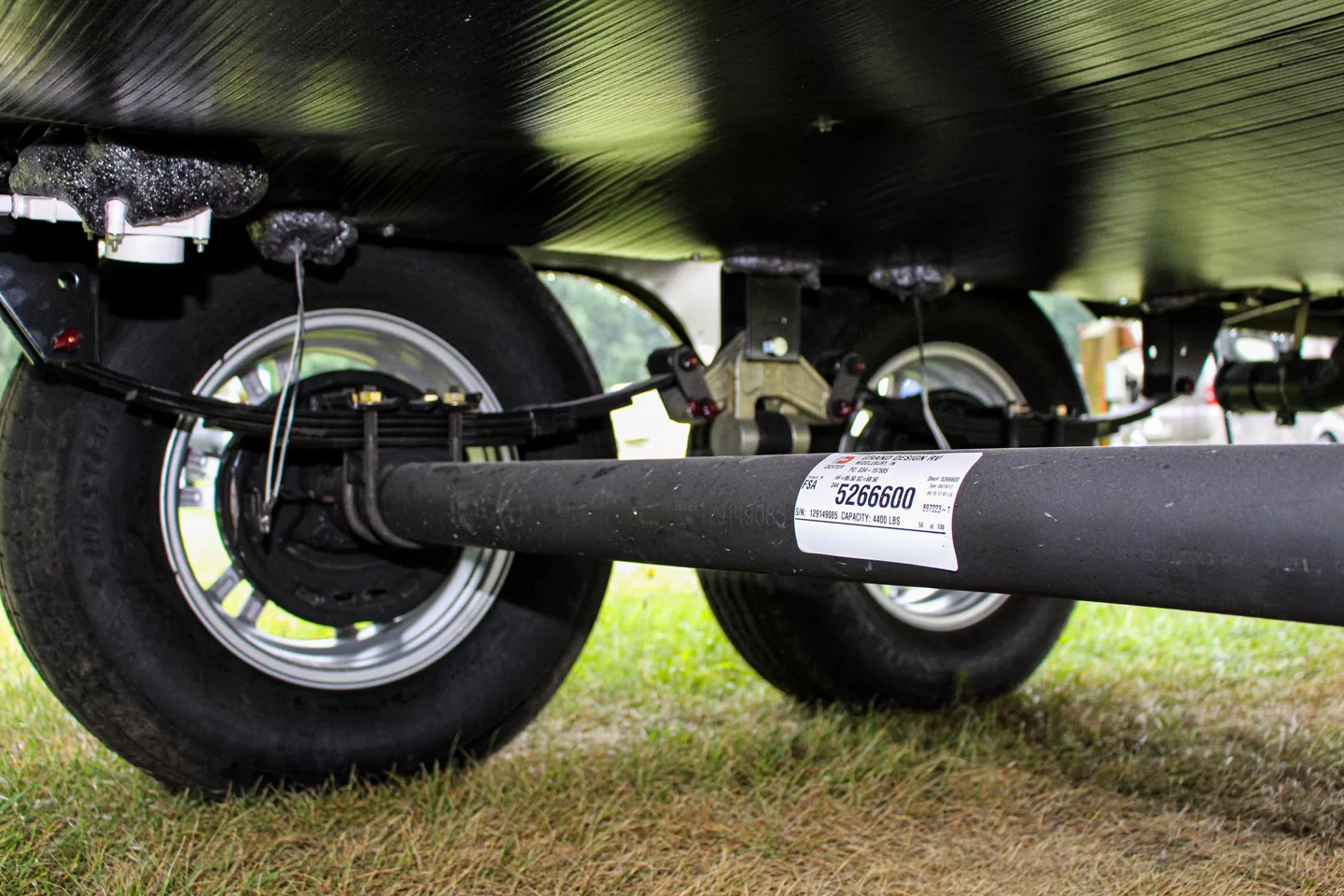
The axles on most trailers have a hollow tube design, with a spindle, brake assembly, hub, and bearing set at each end. Each axle has a specific weight rating, which is printed on a sticker attached to the axle and on the finished trailer’s weight rating label. Under most circumstances, the combined gross axle weight ratings (GAWR) will be less than the gross vehicle weight rating (GVWR) of the trailer, as the hitch or pin is expected to hold a percentage of the weight. Toy haulers are the most common exception, with the sum of the axle ratings exceeding the GVWR because heavy loads are expected occasionally in the garage at the rear of the unit.
Shackle bolts must be inspected and greased; non-greaseable bolts should be removed and serviced yearly, and neoprene bushings and bolts replaced.
It is important to remember that trailer axles are designed to hold a vertical load split between their tires. Since each axle doesn’t support the whole load of the trailer, jacking up a trailer by the axle can cause the tube to become disfigured, throwing the axle out of alignment and potentially leading to tire, axle, and bearing damage or complete failure.
Most trailers utilize electrically operated drum brakes, activated by a brake controller in the towing vehicle. As increasing DC voltage is supplied to an electromagnet in the brake assembly, the magnet attaches to the drum, pulling an actuator lever that pushes the pads against the drums. The more voltage that is applied to the magnets, the greater the stopping power.
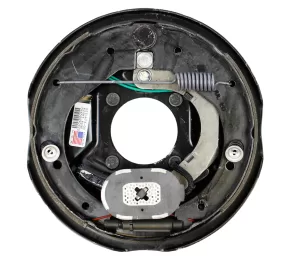
Most electric trailer brakes have an electromagnet that, when energized, attaches to the magnet surface of the drum, pulling the armature and forcing the shoes against the drum’s braking surface.
There are some ways running gear can be upgraded to improve ride and handling or to reduce maintenance. Torsion axles don’t use springs but instead utilize a set of rubber cords inside a square tube that are attached to a torsion arm and spindle. Torsion axles reduce the number of maintenance-required suspension components and allow each wheel to move independently, improving the ride. Hubs and bearings, which require repacking every 12 months or 12,000 miles, can, in some circumstances, be replaced with never-lube or oil-filled bearings, but this may require replacing the drums and axles.
Leaf-spring suspensions can be upgraded with bronze bushings, greaseable shackle bolts, heavier shackles, cushioned equalizers, and shock absorbers. Only higher-end trailers contain some or all these components, but they can be added in the aftermarket.
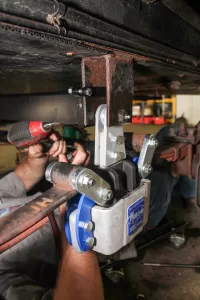
A shock-absorbing equalizer, like this MORryde SRE4000 model, improves ride and handling.
Electric brakes can be upgraded to automatic-adjusting brakes. The standard models require regular maintenance every 12 months or 12,000 miles and adjustment every 3,000 miles. As the name suggests, automatic-adjusting brakes eliminate the adjustment requirement.
Electric brakes can be replaced with hydraulic disc brakes. While this is a complex and expensive upgrade, users report a much better trailer braking experience with less maintenance. For these systems, a hydraulic pump is mounted in the RV (usually a fifth-wheel), and new brake lines are installed back to the axles, where the complete hub assemblies are replaced with hydraulic brakes and new rotors.
Lastly, sometimes a trailer sits too low to the ground or has other clearance issues — for instance, a fifth-wheel that is too low to reach over the bed of a 1-ton pickup. In these cases, it may be possible to gain clearance by flipping the axles. This is a process where the running gear is removed, new brackets are welded to the axles, and the springs are attached to the top instead of the bottom. This adds clearance below, but keep in mind that it also raises the trailer roof clearance and the door height.
MAINTENANCE
Running gear maintenance is easiest when broken down into categories, as mentioned above. If you keep a maintenance log or checklist, this will help track what needs to be done.
Axles: Inspect the axles at least annually but also every time brake/bearing service is done, or if damage or tire wear indicates a problem may exist. When standard tube axles are unloaded, they will have a bend in the middle. The bend flattens out as weight is added up to the rated load of the axle, which is normal. What is key is that the hardware and attachment points/U-bolts be checked for tightness and to look for any sign of axle shift or other damage.
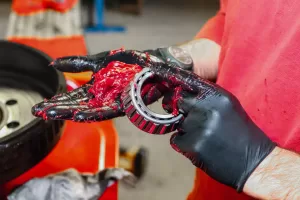
Bearings should be repacked and inspected every 12 months or 12,000 miles.
Bearings: It is recommended that greased bearings be inspected and repacked every 12 months or 12,000 miles, whichever comes first. Repacking must include thoroughly cleaning the spindle, bearings, and races; inspecting for damage; repacking with appropriate axle grease; and replacing the bearing seal on the hub. If bearings are damaged, the bearings and associated races must be replaced as a set.
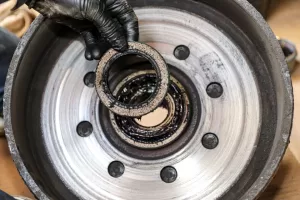
Hub seals must be replaced when repacking bearings.
Brakes: Electric drum brakes require adjustment every 3,000 miles and should be inspected annually when the bearings are repacked. Unfortunately, in the case of electric drum brakes, the components can’t be checked unless the drum is removed. Adjusting them requires the RV to be jacked up so the wheel is clear of the ground and can be spun while the brake adjusting tool is used to move the adjustment wheel in the back of the brake plate. With a hub-off inspection, we’re looking for even wear across the magnet surface; even wear on the shoes, with no broken pieces; and springs in good condition. The hubs also must be inspected, mostly for wear to the armature surface, which is the smooth surface on the inside face of the drum where the magnet sticks when applied. If the magnet is worn down into the coil, is worn unevenly, or there are any other broken parts, replacement of the entire brake assembly is recommended. While you may be able to purchase individual components, the entire assembly is reasonably priced, and everything will be new.
Suspension: Spring suspensions, shackles, bolts, bushings, and equalizers all see tremendous mechanical wear and can fail from abuse. Many trailers come from the factory with non-greaseable bolts and plastic bushings, which wear very quickly. While greaseable bolts and bronze bushings also will wear over time, they tend to last longer and to be more reliable. Look for signs of wear on bolts and shackles, uneven tire wear side to side, and movement wear around the attachment points. Lifting the trailer and checking for looseness and slop in the attachment points can indicate worn components. Suspension upgrade kits with improved equalizers and wet bolts and bushings are available from several vendors, including Dexter, Lippert, and MORryde.
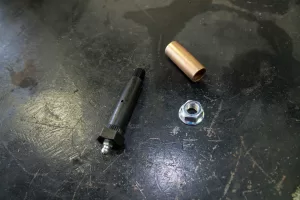
Shackle/spring bolts can be replaced with wet bolts and bronze bushings while servicing the axles.
Torsion axles are primarily maintenance-free, aside from checking the attachment points at the frame. The hub assemblies have the same maintenance requirements as noted above. The rubber cords, if visible, must be inspected for damage. Also, keep an eye on all weld points on the axles and frame for cracks, and have them repaired by a certified technician immediately if any are found.
As with your car, trailer hydraulic disc brakes require at least an annual visual inspection for pad wear and maintaining fluid level. Otherwise, no adjustments are necessary. The pads are visible behind the wheel without the need to remove anything.
While this article is not about tire wear or maintenance, it is worth noting that proper visual inspection of travel trailer tires and maintaining proper inflation are essential. Poor tire wear is an early indicator of running gear problems. If you notice uneven tire wear, it’s worth investigating the possible reasons. Some signs of tire wear are inflation and/or loading related, such as increased center tread, or outer tread wear on both sides of the tire. Cupping, single-side tread wear, and a sawtooth tread pattern on both tires on one axle often are related to alignment or component issues. Of course, handling problems, including trailer sidetracking or rubbing tires, are an immediate concern.
Your trailer’s running gear keeps you on the road, and maintaining it is vital to enjoyable travel and continued safety. If you don’t want to complete the maintenance yourself, you must have it done by a professional, following the manufacturer’s service recommendations. If you want to learn more about doing the work yourself, Lippert and Dexter have detailed directions and videos to teach you.
RESOURCES
Dexter Axle Company
www.dexteraxle.com
Lippert
www.lci1.com
MorRyde
www.morryde.com
Tim’s RV Inc.
Erving, Massachusetts
www.timsrvinc.com