
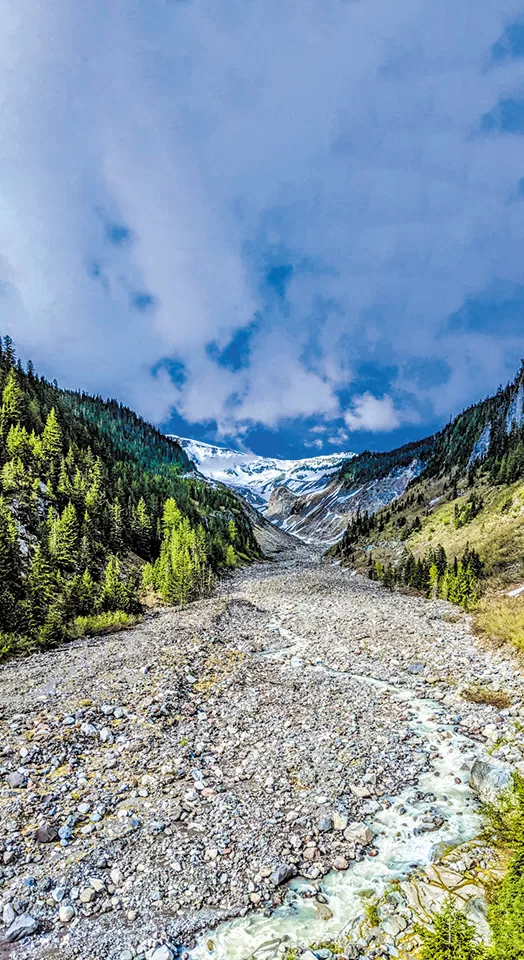
Known especially for its rugged mountains, towering pine forests, and dramatic coastline, the Pacific Northwest beckons RV travelers.
By Pat Jennette, F505807
October 2023
When conservationist John Muir — often called the “father of our National Park System” — led an exploration across the region that is now Washington state, his efforts inspired the establishment of three national parks: Mount Rainier, North Cascades, and Olympic. We set out to see these parks, the San Juan Islands, and more.
Traveling with our Keystone Outback toy hauler towed by our Chevy Silverado 3500 truck, we headed toward Astoria, Oregon, on the Oregon-Washington border. The grand Astoria-Megler Bridge over the massive Columbia River provides an excellent starting point to explore Washington. The bridge stretches just over 4 miles from Astoria to Point Ellice (near Megler), Washington, and is the longest continuous-truss bridge in North America. Not to be missed while there is the 125-foot Astoria Column. This intricate hand-carved structure overlooking Astoria and the Columbia River tells the region’s history.
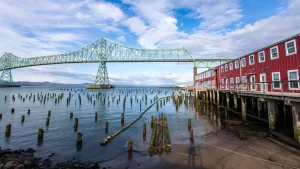
Astoria-Megler Bridge is a steel cantilever through-truss bridge spanning the Columbia River.
Also in this area, the Lewis and Clark National Historical Park along the Columbia River encompasses a collection of sites that share the story of the famed expedition. Captains William Clark and Meriwether Lewis arrived in this area after traveling across North America from 1804 to 1806. President Thomas Jefferson enlisted them to find the most direct route to the Pacific Ocean and to serve as ambassadors to Native American tribes along the way.
Our next stop was Mount St. Helens National Volcanic Monument. Rising to 8,363 feet, this active stratovolcano is still smoldering since its eruption in 1980, which was declared the most disastrous volcanic eruption in U.S. history. More than 50 lives were lost, and hundreds of structures were destroyed.
Although the visitor center volunteer indicated rainy, cloudy weather at the top, we drove up anyway, to see only the base from beneath the clouds. Heading back, we read displays at viewpoints and noted valleys of new growth and lakes created or enlarged from the eruption. It was worth the drive for the knowledge we gained and to see the geographical layout.
We next visited Mount Rainier National Park. As is our routine, we snapped an entrance sign picture and stopped at the visitor center to get passport stamps, ask questions, and pick up information and souvenirs. Mount Rainier, at 14,410 feet, is the most glaciated peak in the contiguous United States.
We stayed at the Silver Springs Campground, located one mile from the north entrance of the park and within Mt. Baker-Snoqualmie National Forest. Since it was late May, the upper portion of Mount Rainier was not yet open. However, the main road through the eastern and southern areas was wide open and cleared of snow. We explored Paradise, Longmire, and some of Ohanapecosh, and we then hiked to Box Canyon.
In full spring glory, waterfalls cascaded down mountainsides, under bridge crossovers, and at trailheads. We drove snowy park roads and passed by mostly frozen lakes, and then we warmed up at the Paradise Inn. We were told that you’re fortunate if you can see Mount Rainier. Because of its own weather pattern, it’s often clouded over. We were blessed to see it both days!
Next, we arrived at a county fairgrounds near Seattle where we spent the night. The campground was reasonably priced, basic, and convenient to the city. We visited a longtime friend and indulged in seafood at The Fisherman’s Restaurant near Pike Place Market. We then went in search of the Wing Luke Museum and the Klondike Gold Rush Monument.
Established in 1967, the Wing Luke Museum is associated with the National Park Service and is the first Smithsonian affiliate in the Pacific Northwest. Offering exhibits and also tours of historic buildings and Chinatown, the museum provides insight into Asian culture and history. The facility encompasses 60,000 square feet and three floors of exhibits that tell the stories and showcase the artwork of Asian Americans, Native Hawaiians, and Pacific Islanders.
The Seattle Unit of Klondike Gold Rush National Historical Park helps visitors understand how the city played a role in the mad rush for gold in the Alaskan hills. While the central location is in Skagway, Alaska, Seattle was the gateway city for those heading north in pursuit of gold and, as a result, flourished.
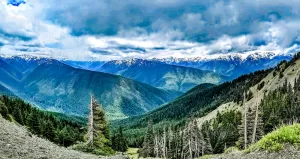
Hurricane Ridge in Olympic National Park offers stunning views.
We arrived next at the Olympic Peninsula/Port Angeles KOA Journey to the north. It was an excellent choice for an RV stay, with reliable internet access and meticulous landscaping set under the shadows of the grand Olympic Mountains, plus various amenities.
Olympic National Park occupies nearly one million acres of the Olympic Peninsula. It features three distinct ecosystems: the snowcapped and glaciated mountains of Hurricane Ridge; the Hoh Rain Forest, filled with moss and wetlands; and 73 miles of Pacific Ocean coastline. Beautiful Lake Crescent offers an RV park overlooking the lake.
Hurricane Ridge is the key vantage point for the snow-covered mountain ranges, and we were fortunate to view it without clouds and fog. Sadly, on May 7, 2023, the Hurricane Ridge Day Lodge, which served as a visitor center, burned to the ground. While visits are still being allowed on a limited basis, no facilities currently are available.
Afterward, we drove along Lake Crescent and hiked to Salmon Cascades. Lake Crescent is a glacially carved lake that is home to Crescenti and Beardslee trout. The distinctly native species of freshwater trout resulted from genetic isolation that occurred after a landslide thousands of years ago split the waterway into two bodies of water – now Lake Crescent and Lake Sutherland. Salmon Cascades is 5 miles up Sol Duc Road and has a viewing platform to watch salmon leap up waterfalls.
Don’t miss visiting the Hoh Rain Forest, which is on the west side of Olympic National Park and a two-hour drive from Port Angeles along the Pacific Coast. Allow enough time, as the map is deceiving, and travel may be slow in some areas. On average, 12 feet of rain fall here annually. During our mile and a half hike on the Spruce Trail, we marveled at drooping trees and fields of ferns heavily laden with moss.
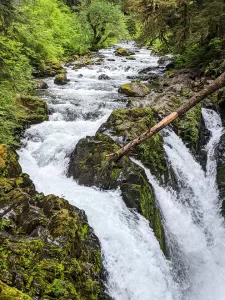
Sol Duc Falls is surrounded by lush landscapes.
The next day we hiked to Sol Duc Falls. While not a difficult trek, it involves a series of wooden stairs and patches of tree roots. The park ranger encouraged this hike for the reward at the end: powerful, rushing water cascading simultaneously over quadruple falls under a beautiful bridge and overlook. Nearby Sol Duc Hot Springs Resort is popular with visitors desiring to enjoy its mineral-water hot springs. The resort operates a campground also, with reservations available at recreation.gov.
Our next destination was the San Juan Islands, and their sister islands, Whidbey and Camano. Departing Port Angeles, we drove to Port Townsend and boarded the ferry with our RV in tow for Whidbey Island. After checking into the lovely Pioneer Trails RV Park in Anacortes on the island’s north end, we went in search of fresh seafood. Historical Anacortes is a delightful, artistic harbor town. Its main street is lined with a multitude of restaurants, and many have outdoor seating. We chose one and had our seafood meal.
The next morning, we drove our truck onto the ferry and crossed the sea for a full day on San Juan Island. The San Juan Islands, north of the Olympic Peninsula, are an archipelago made up of 172 named islands spread out across the Salish Sea. Four major islands are reachable via the Washington State Ferry system: San Juan, Orcas, Lopez, and Shaw.
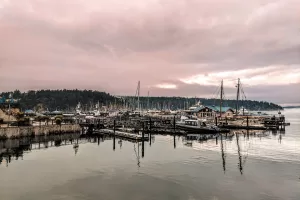
The ports of San Juan Island are home to many fishing boats.
Be sure to make reservations for the ferry, as spots fill up quickly, especially during the tourist season. At 14.5 miles long and 6.5 miles at its widest point, San Juan Island is easily drivable. All told, it’s just 41 miles around. San Juan is laid back and easy-going. Attractions include quaint Friday Harbor with shops and restaurants; rolling countryside farms; sea views; lavender and alpaca farms; orca whale watching; and the American and English Camps of San Juan Island National Historical Park. Mist and rain provided opportunities to capture snapshots of the infamous fog that often rolls across the island.
At Krystal Acres Alpaca Farm, we fed alpacas and visited the store showcasing items made from the animals’ fleece. This 40-acre family-run farm was established in 1996. The farm’s store is stocked with yarns, hats, shirts, socks, headbands, and much more.
Friday Harbor presents an array of quaint shops and restaurants. This walkable seaport is close to the ferry landing, various museums, and tours. We visited a chocolate and port-wine store and grabbed a fish sandwich. Afterward, we took cover from the wet, cool weather in one of the harbor restaurants for dessert and a warm drink.
We then boarded the return ferry back to Anacortes on Whidbey Island. Whidbey Island and its Ebey’s Landing National Historical Reserve offer lessons in history, with many interesting structures throughout. We toured Fort Casey, explored the Island County Historical Society And Museum, visited the historic town of Coupeville, and walked to the Admiralty Head Lighthouse.
A small bridge connects Camano Island, located east of Whidbey, to the mainland. It was easy to navigate with the RV. After setting up camp at Camano Island State Park, we headed out to visit a longtime friend and colleague we hadn’t seen in decades.
Having learned that Pacific Northwest folks are very focused on fishing and seafood, we’d been on a hunt to find fresh crab and salmon this whole trip. We discovered that it was in short supply because the active fishing season didn’t start until July. We mentioned this dilemma to our friend, and she arrived the next day with a large bag of crab from her daughter’s freezer. After she showed us how to crack crabs and pull out the meat, it became that evening’s dinner.
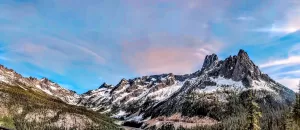
Washington Pass Overlook is the highest point on the North Cascades Highway.
Next stop was North Cascades National Park, often called the “American Alps.” Its sheer size, turquoise lakes, and endless snowcapped mountain spires take one’s breath away One of the least visited of the 63 U.S. national parks, North Cascades shares the border with British Columbia in Canada. More than 300 glaciers have carved mountains into a nature lover’s delight for hikers, kayakers and boaters, anglers, and campers. Much of the subalpine landscape of this 505,000-acre park makes it an ideal environment for wildlife that call it home. Wolves, lynx, moose, bears, and deer live there, peregrines nest there, and fish are in abundance.
We hiked along crystal-clear streams of cold glacier water. We kayaked on the turquoise Diablo Lake. We viewed dozens of roaring waterfalls, as the snowmelt was at its peak. We hiked up to the jaw-dropping Washington Pass.
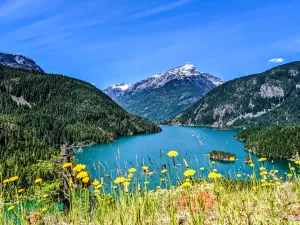
Diablo Lake is a glacier-fed reservoir surrounded by rugged mountains.
We headed south next to visit Leavenworth. Today, the town has a Bavarian theme, but that wasn’t always the case. Pioneers laid out a community there when they learned that the Great Northern Railway was going to lay tracks through the region. A town sprung up with all necessary amenities, including a lumber mill. By 1920, the railroad rerouted its lines and the timber supply dried up. A local group established a Bavarian village in the 1960s to encourage tourism. This now immensely popular town overflows with flower baskets and planters, and horse-drawn carriages take passengers for rides among buildings with Bavarian-themed architecture.
We dipped into the Baren Haus for a German meal and then took a stroll. We stayed that evening at Wenatchee River County Park. It was among the most well-kept, cleanest RV parks we’d experienced, with bronze sculptures, an outdoor fitness center, and beach access along a lovely river.
As we wound down our Washington experience, we stopped at Coulee Dam, Lake Roosevelt National Recreation Area, and then the Whitman Mission National Historic Site. With so much more to see in this spectacular state, we’ll need to return someday.
CAMPGROUNDS
Camano Island State Park Campground
2269 S. Lowell Point Road
Camano Island, WA 98282
www.parks.wa.gov/484/Camano-Island
(360) 387-1550
Olympic Peninsula/Port Angeles KOA Journey
80 O’Brien Road
Port Angeles, WA 98362
koa.com/campgrounds/port-angeles
(800) 562-7558
Pioneer Trails RV Park
7337 Miller Road
Anacortes, WA 98221
www.pioneertrails.com
(360) 293-5355
Silver Springs Campground
68317 State Route 410
Enumclaw, WA 98022
www.recreation.gov/camping/campgrounds/232298
Wenatchee River County Park
2924 State Highway 2
Monitor, WA 98815
www.wenatcheeriverpark.org
(509) 667-7503