
If you’re a nature lover or a science nerd, visit this fantastic Florida museum located between Tampa and Sarasota.
By Bert Henderson, F385218
March 2024
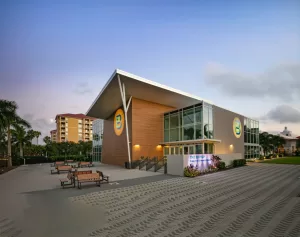
The Bishop Museum of Science and Nature houses one of the largest collections of natural history specimens in the world.
Traveling with children and grandchildren is a great way to keep the family dynamic alive. Our youngest grandson, Brandon, loves museums and especially ones that have fossils. Because of that, and at our oldest daughter’s behest, we recently made a day trip to The Bishop Museum of Science and Nature in Bradenton, Florida.
I had heard good things about The Bishop Planetarium years before but nothing about the museum. Thanks to our visit, I learned that the museum specializes in the history of Florida’s Gulf Coast. Founded in 1947 by Dr. William D. Sugg, the facility features exhibits that highlight Florida history from prehistoric times to the present day. The museum originally opened downtown on Memorial Pier, along Bradenton’s waterfront, and moved to its current location in 1966.
Exhibits document thousands of years of human habitation in Florida.
Today, the 80,000-square-foot museum fills an entire city block with educational experiences. Featuring The Planetarium, the Parker Manatee Rehabilitation Habitat, and the Mosaic Backyard Universe, this facility also boasts the largest collection of Florida natural history and science objects on the state’s Gulf Coast. The museum also preserves ancient artifacts — originating from the Paleo-Indian period, native Floridian tribes, and Spanish explorations — that document Florida’s history over 10,000 years.
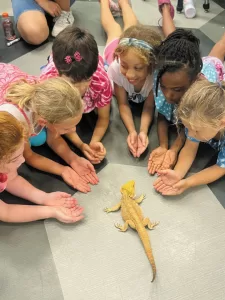
Interactive learning enables an up-close look at wildlife, like this sunburst lizard.
The museum staff works closely with construction and fabrication companies and artists to bring their 14 permanent exhibits to life. In addition, an ever-changing array of temporary exhibitions provides something new for every visit.
When we arrived in Bradenton, the futuristic building caught our eye. That kind of landmark makes the museum easy to find. You have to drive around to the front of the museum, so following the directions of your GPS might be confusing.
Our daughter, Deanne, has an electric Jeep, so we found a parking place in one of the charging zones out front. She drove to the museum from her home in Seminole using no gas — just her electric motor. The charge her batteries took at The Bishop was enough to get us back to Seminole.
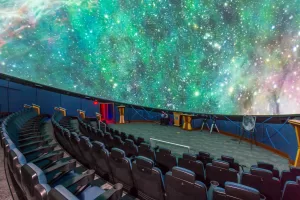
Explore the universe at The Planetarium’s 50-foot domed theater.
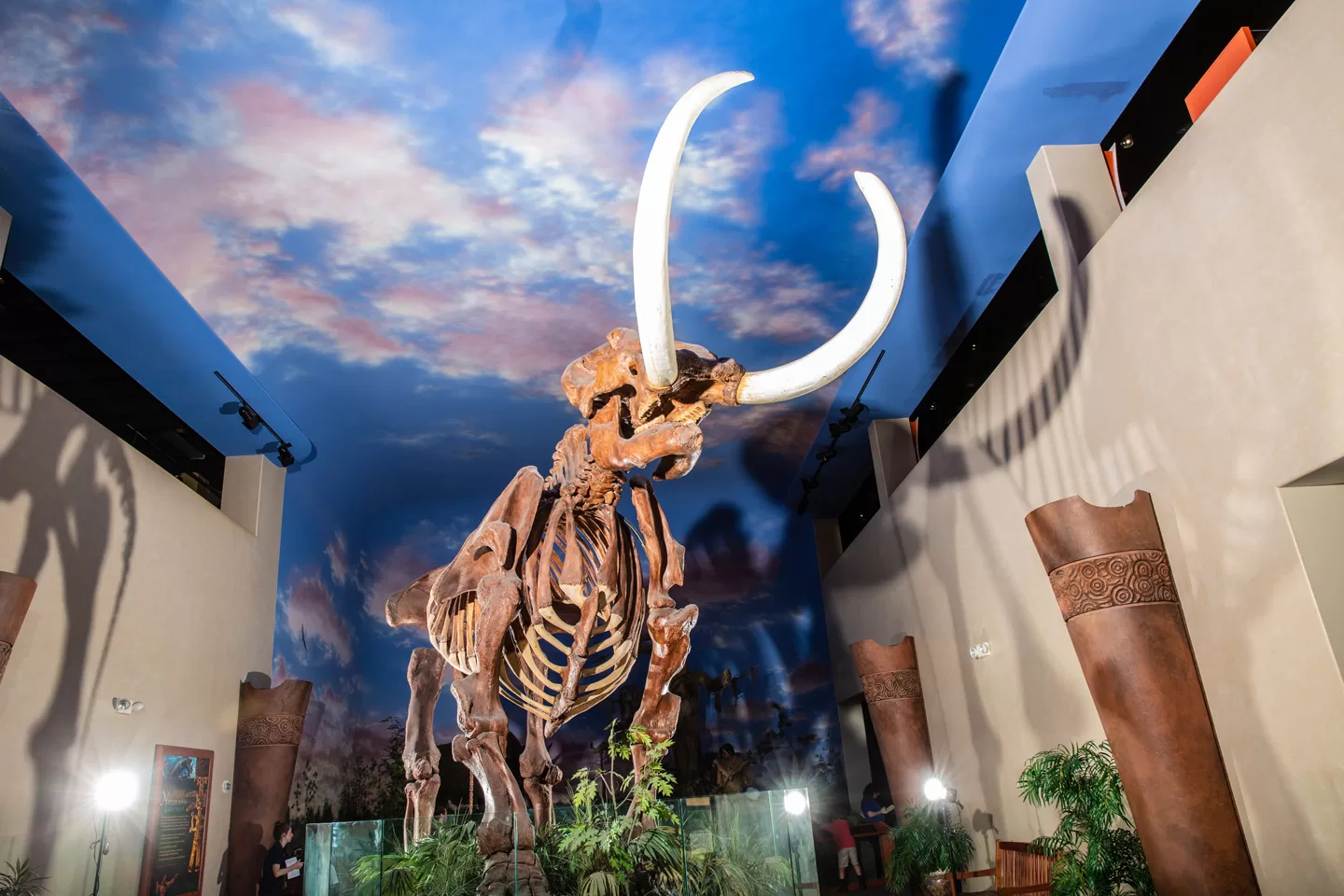
After paying our admission, we entered the main lobby and were greeted with a spectacular view of an extinct ice age mammal: an American mastodon. The museum does not have dinosaur fossils, because the area that we now call Florida was still underwater when dinos roamed the Earth. The skeletal fossils they do display hail from the ice age era and are native to Florida. The mastodon, named Priscilla, stands 11 feet 4 inches at the shoulder and is one of the largest recovered in North America. According to the museum, the fossil was found in 1967 by Don Serbosek, a diver, in the Aucilla River in Jefferson County. The mastodon definitely impressed 9-year-old Brandon.
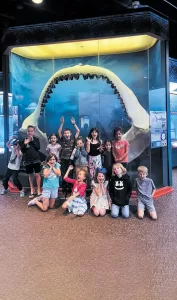
This megalodon replica at The Bishop illustrates the enormity of the prehistoric creature.
Other first-floor exhibits focus on Paleo-Indian, Archaic, and pre-contact cultures. Additional areas include the Great Hall, Land of Change, Fabulous Florida Seas, Archaic Peoples, and the Tallant Gallery; the latter examines Florida’s Gulf Coast in prehistoric times.
We went to The Planetarium to catch the showing of “Passport to the Universe.” The 20-minute video provided a way to travel through the observable universe to explore our “cosmic address.” The excellent 360-degree film is narrated by actor Tom Hanks and produced by NASA. The program received a thumbs up from Brandon. Other videos shown in The Planetarium include “To Space and Back,” “Big Astronomy,” “Black Holes,” and “Firefall.” Another video, called “Sky Tours,” is presented by an astronomy educator to explore the night sky. That schedule alone can keep you busy for the day.
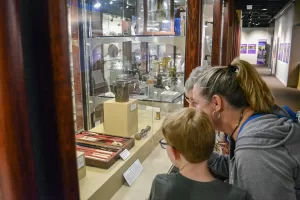
The Visible Storage Gallery reveals an eclectic assortment of items.
We also were impressed by the megalodon jaw in the main exhibit hall. Megalodon means “big tooth,” and it is an extinct species of the mackerel shark that lived about 3.6 to 23 million years ago. “Megalodon jaws were cartilage, so they do not fossilize. When you see them on display, they are fabricated, but nonetheless impressive,” said Michael Winters, The Bishop’s manager of marketing and design.
On the second floor is the Visible Storage Gallery, where selected objects are exhibited that otherwise would be stowed “behind the scenes.” Nearby, the River Heritage Hall explores the rich cultural history surrounding the Manatee River and Tampa Bay area, educating visitors about everything from the pioneers and scientific expeditions to industrialization and tourism in Bradenton. In the Environmental Hall, exhibits focus on environmental awareness of the region’s unique biodiversity.
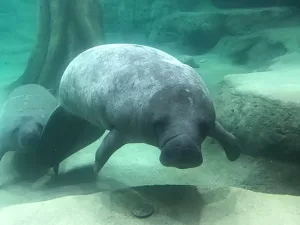
The Parker Manatee Rehabilitation Habitat houses rescued manatees.
At this writing, the featured temporary exhibit, which runs through April 2024, is “Bird Photographer of the Year.” The display showcases winning and finalist images taken around the world that, according to the museum website, “capture the beauty, drama, and intricate details of avian life.”
Enhancing all the great exhibits, artwork placed throughout the museum provides a complete visitor learning experience.
There are two ways to view the Parker Manatee Rehabilitation Habitat. You can either go upstairs and look down into the water or use the viewing windows on the lower level. The Bishop usually cares for juveniles who have not spent much time in the wild, so the goal is to prepare them for release. The target release weight is 600 pounds.
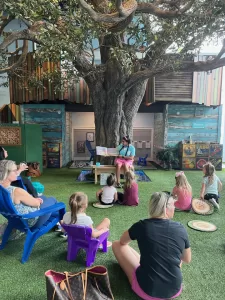
The Mosaic Backyard Universe offers “backyard science” programs.
Two manatees were in rehab during our visit — Tober and Ripkin.
Tober weighed 44 pounds when he was rescued, and Ripkin weighed 201 pounds. ZooTampa at Lowry Park is the closest acute-care manatee hospital, so a transfer from/to that facility is easiest for the creatures. The Bishop is also involved in retrofitting a retired sea lion facility in Myakka City and was recently approved for acute-care status to become the next manatee critical-care facility in Florida.
The indoor Mosaic Backyard Universe offers hands-on experiences. In this ADA-accessible area decorated with scale models of our solar system, kids of all ages can check out a freshwater turtle pond; use tools of the trade in the Science Shed; and climb the sculpted Mighty Oak Tree, complete with a treehouse platform. There’s also the Cardboard Rocket, which provides a virtual immersion in the microscopic world, to places around the Earth, and farther out to the wonders of space.
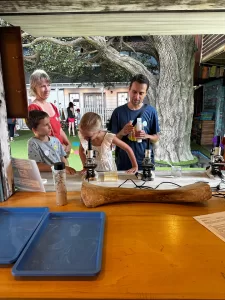
Visitors can try out microscopes and other scientific equipment.
“We are a museum of science and nature, so we focus on educating people of all ages about Florida’s natural history and pre-history, the environment, the universe, and manatee rehabilitation and awareness. We strive to provide additional educational resources to students through our learning programs,” Winters said. A full- and part-time staff of 40 provide The Bishop with additional educational programs for students, including Homeschool Days, iQuest, Science Sprouts, and spring and summer science camps. Scholarships are awarded to campers.
“Our entire goal is to ignite a passion for science and nature to transform our community and the world,” he added.
MORE INFO
The Bishop Museum Of Science And Nature
201 10th St. W.
Bradenton, FL 34205
bishopscience.org
(941) 746-4131