
By Randy Davis, F471978
March 2024
Knowing the risk factors and the symptoms — and taking preventative measures — can help to avoid a potential tragedy.
The risk of experiencing deep vein thrombosis (DVT) can be very real for those of us who enjoy the RV lifestyle. Long-distance travel that lasts many hours may place us at risk of developing a blood clot, which could lead to a life-threatening pulmonary embolism (PE).
Just imagine driving nonstop for hours and then feeling a sudden pain in your leg, with warmth and even numbness, but you keep on going. The next sensation could be sudden shortness of breath and chest pain upon coughing or deep breathing. You could be experiencing DVT or PE. The hope is that this will only put you in the hospital and not lead to your death. In either case, your spouse or traveling partners could end up in the middle of nowhere with no family or friends to help. The same may be true for your RV. The good news is that this potential tragedy can be prevented.
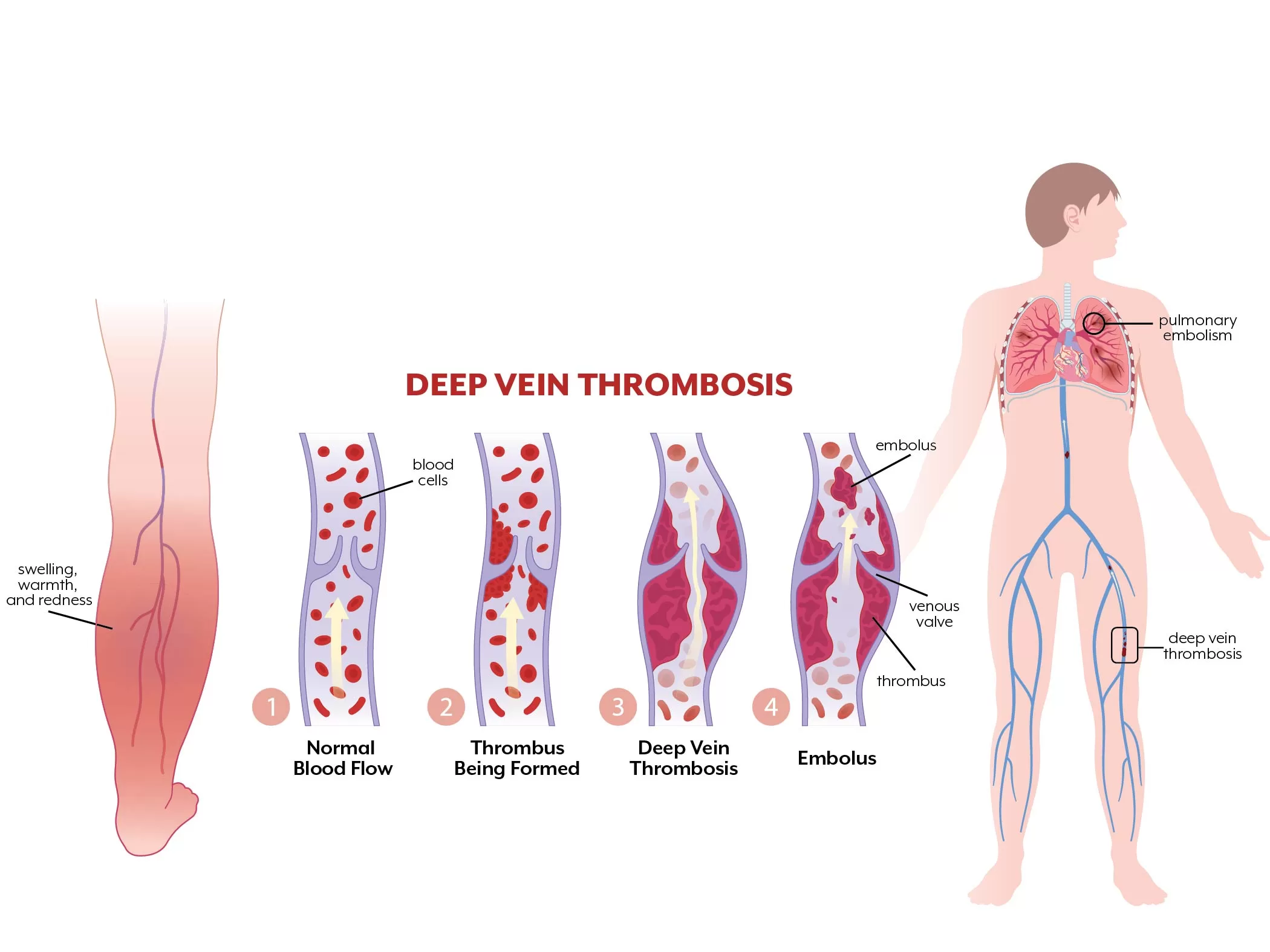
Deep vein thrombosis, or DVT, is simply a blood clot that forms in large veins, usually in the lower leg, thigh, or pelvis. They can occur in other parts of the body as well, such as the arm. The clot can impede or slow blood flow in the vein, causing swelling and pain in the area. There is a danger that little pieces of the clot (emboli) could break off and travel to the lungs. This may create a pulmonary embolism (PE) and block blood flow to areas of these vital organs. Anything that slows or impedes blood flow, damages a vein, or affects blood clotting can cause DVT.
The Centers for Disease Control and Prevention estimate that as many as 900,000 people in the United States may be affected by DVT and PE each year. The actual numbers are unknown. They also estimate that up to 100,000 Americans die of a DVT/PE yearly.
Risk factors include:
- Age over 60, although DVT can occur at any age.
- Lack of movement.
- Recent injury or surgery.
- Hormone replacement therapy/birth control pills.
- Pregnancy and postpartum period of six weeks to three months.
- Being overweight.
- Smoking.
- Cancer and cancer treatments.
- Heart disease.
- Lung disease.
- Inflammatory bowel disease.
- A personal or family history of DVT.
If you have swelling in a leg, which may also be warm and painful, and even have some discoloration or bruising, you could be experiencing symptoms of DVT and should be checked by your physician. Get immediate emergency medical care if you have sudden shortness of breath, experience pain upon deep breathing or coughing, or are coughing up blood. The latter could be signs of a pulmonary embolism. Just remember that according to the National Institutes of Health, 30 to 40 percent of people will not have typical DVT symptoms and may not realize they have a deep vein clot until a more serious condition develops. That is the reason you need to know risk factors and how to prevent DVT.
Treatment includes compression stockings and blood thinners. It can also be as drastic as having a filter placed in your deep veins to keep clots from moving to your lungs. Prevention is much better than treatment.
To prevent DVT, you must move! Don’t just sit there for hours on end. When you move, the contracting muscles help the blood in veins to flow. Blood in arteries is under pressure, which keeps things flowing; veins must rely on the contraction of muscles and the opening and closing of valves to move blood back to the heart. When blood is not flowing well in veins, it can clot more easily, potentially leading to DVT.
When traveling, we try to stop at least every couple of hours to “stretch our legs.” We walk the dog and ourselves. This gets the blood flowing and helps keep us fresh. While driving and using cruise control, or while sitting and watching TV, I also point my toes up and down by flexing my feet to get my calves to contract and help blood flow.
Even if you must be somewhere at a certain time, a 10-minute stop every couple of hours will not make a big difference in your time, but it can make a big difference in your health and safety. Besides, RVing is about enjoying the journey as much as the destination. Stop occasionally to appreciate the scenery and smell the roses, while walking and moving to prevent DVT and to avoid what could be a tragedy.
Randall J. (Randy) Davis is a nationally registered paramedic licensed in Missouri and Kentucky. His EMS career has spanned more than 40 years, first as an EMT in 1979, then as a paramedic beginning in 1981. He has presented numerous life-support classes for the American Heart Association, the American Academy of Pediatrics, and other nationally accredited education programs.
LEARN MORE
Centers For Disease Control And Prevention
cdc.gov/ncbddd/dvt/travel.html
Mayo Clinic
mayoclinic.org/diseases-conditions/deep-vein-thrombosis/symptoms-causes/syc-20352557
National Institutes Of Health
newsinhealth.nih.gov/2017/01/how-spot-prevent-deep-vein-thrombosis