
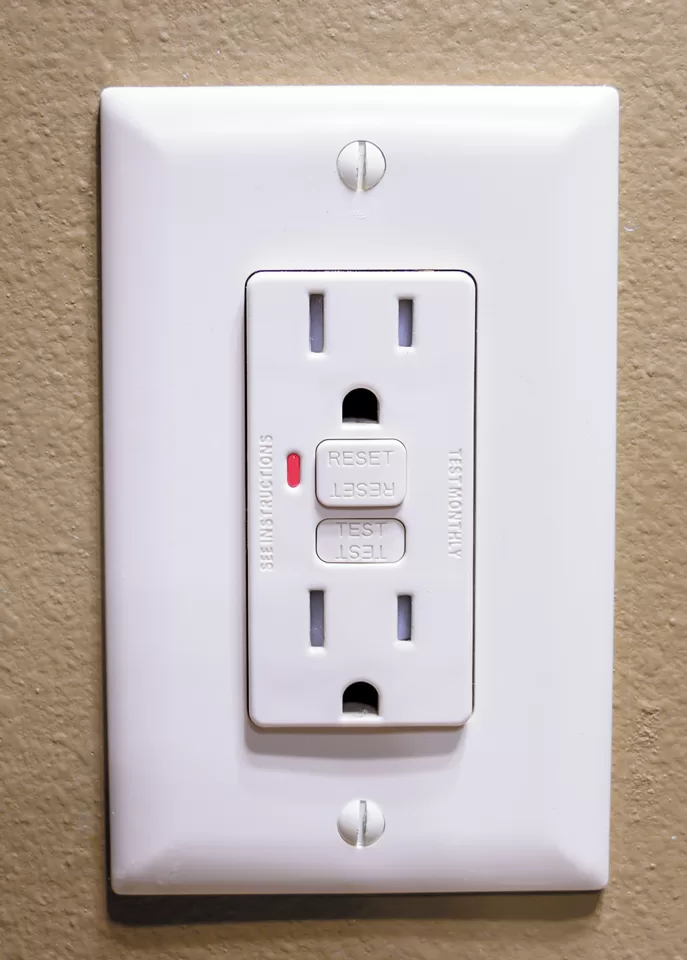
Learn more about ground fault circuit interrupters, which help to protect people from severe electrical shocks.
By Steve Froese, F276276
April 2024
The internet is rife with information, and it is almost impossible to spot the difference between fact and fiction. I have written an article about this quandary in the past (“Consider The Source,” September 2023 Tech Talk e-newsletter). FMCA is committed to providing members with the most reliable information possible. I sometimes team up with other trusted industry professionals to communicate accurate information. This month, I called on Mike Sokol from RVelectricity.com to provide his expertise for some of the content in this article. This month’s topic is ground fault circuit interrupters (GFCI), including the basics of how they work and their relevance to RVs.
According to U.S. and Canadian codes related to RV construction (including, but not limited to, UL, CSA, and NFPA), all RVs must utilize GFCI circuits in the kitchen, bathroom, and any other location that may get wet, as well as exterior locations (except the fridge). Most stationary homes built after a certain year have similar requirements.
Electrical current can only flow through a closed circuit. In other words, the power travels out the hot wire(s), through the load, and back through the neutral wire. If the circuit is broken or discontinuous, such as by an open circuit or switch, the current flow stops. In theory, the same amount of current must exit and return to the voltage source. If some of this current is lost through leakage at the load or conductors, a current imbalance will exist between the hot and neutral. Such loss is bled to the ground wire, and, by extension, to the RV chassis (and potentially to a human). An excessive amount of leakage current creates a dangerous situation that can lead to electrocution injury. A GFCI device will protect against this by tripping if the current imbalance is greater than 5 milliamps (mA). Note that a GFCI is not a current-limiting device; this function is taken care of by the branch circuit breakers. Therefore, GFCI devices do not replace circuit breakers; however, they may be integrated with them.
Almost all electrical devices incur some level of leakage, and a leakage rate of 0.8 mA for an appliance or device is permitted by code. Even a rate of 5 mA, at which a GFCI device will trip, is considered safe.
A GFCI device is designed to protect a single load on a single branch circuit. Let’s examine residential wiring as an example. If a house has 150-amp service, this means the total current available at the main breaker box is 150 amps, distributed among the various branch circuits. The main incoming power distributed to each circuit is referred to as the “feeder.” Each branch circuit is fed by an individual circuit breaker in the main panel.
A GFCI device in a house may take the form of a GFCI breaker (GFCI device and circuit breaker combined) or a GFCI receptacle. Individual branch circuits (the circuit fed by a single circuit breaker) may have a GFCI device, such as in a kitchen, bathroom, or outside receptacle. That is why I say a GFCI is designed to protect a single branch circuit. In this case, a single load, such as a hair dryer, should have significantly less leakage than the 5 mA required to trip a GFCI device.
Now, let’s examine the scenario where an RV shore cord is plugged into a residential GFCI-protected outlet. This is a common occurrence, since outside residential receptacles are generally GFCI-protected. Instead of having a single load on a single branch circuit protected by the GFCI, the entire RV is plugged into the GFCI receptacle. So, an entire feeder circuit is being serviced by the GFCI device rather than a single branch circuit. This equates to all the branch circuits in the RV. That means leakage from each device in the RV is added together and presented to the GFCI device. There are potentially some very high-leakage devices in an RV that would not trip a GFCI device when taken individually, but when added together, they will exceed 5 mA. For instance, most filter capacitors used on RV control boards (fridges, water heaters, furnaces, etc.) have a leakage level that can exceed 1 mA. Similarly, metal oxide varistors (MOVs) in surge protectors and radio frequency (RF) filter capacitors used in inverters and power converters have a high leakage current, so they have a UL exception allowing up to 3 mA of line-to-ground current.
Since the entire RV is now plugged into a residential GFCI-protected circuit, the residential GFCI trips, even though the GFCI circuits in the RV do not. Each GFCI circuit in the RV is feeding a single branch circuit, while the one in the house is feeding the entire RV, and the leakage current from each device in the RV is adding together. Often this creates a condition in which the total leakage is greater than 5 mA.
Therefore, it is normal and generally expected that an RV plugged into a GFCI device at a home or business will cause the device to trip. It usually does not mean something is wrong with the RV. If you have the option, plug the RV into a non-GFCI-protected outlet. This is perfectly safe, since the RV itself is protected. It may occur to you to turn off all the loads in the RV and then turn them on individually until the GFCI in the house trips. However, this is usually not helpful because — as mentioned — it tends to be a combination of circuits that, when added together, cause the GFCI to trip. It’s not a bad idea to try this experiment, though. If you find that a single circuit by itself causes the GFCI to trip, you should have your electrical system inspected by a professional RV technician.
A related myth I have seen propagated on the internet is that the reason the GFCI device trips is because the RV and house GFCI circuits are being connected in series. This does not cause the GFCI to trip. It is not the GFCI devices being connected that causes the nuisance tripping, but rather the situation explained in this article.
If you have experienced a tripping house GFCI when you plugged in your RV, I hope this article puts your mind at ease. As mentioned, generally there is nothing inherently wrong with your RV based strictly on the tripping of the GFCI. However, a leakage rate over 5 mA caused by a single load should be a red flag for an RV owner.
My thanks to my friend Mike Sokol for providing some of the technical information for this article.
Send your troubleshooting questions to Steve Froese at techtalk@fmca.com. The volume of correspondence may preclude personal replies. Not all responses will apply in every instance. Some situations may require a visual inspection and hands-on testing. If you choose to follow any procedures outlined in this column, first satisfy yourself that neither personal nor product safety will be jeopardized. If you feel uncomfortable about a procedure, stop and make an appointment with an RV service facility. You may also want to consult the FMCA Forums (https://community.fmca.com) to see whether your question has already been addressed or, if not, to post it.
Recalls
Looking for the latest RV-related recall information? Visit FamilyRVingmag.com for a list of the most recent recalls issued by RV and component manufacturers. Or, to search for recalls, investigations, and complaints by vehicle year, make, model, and VIN, visit nhtsa.gov/recalls. NHTSA’s Vehicle Safety Hotline is (888) 327-4236.