
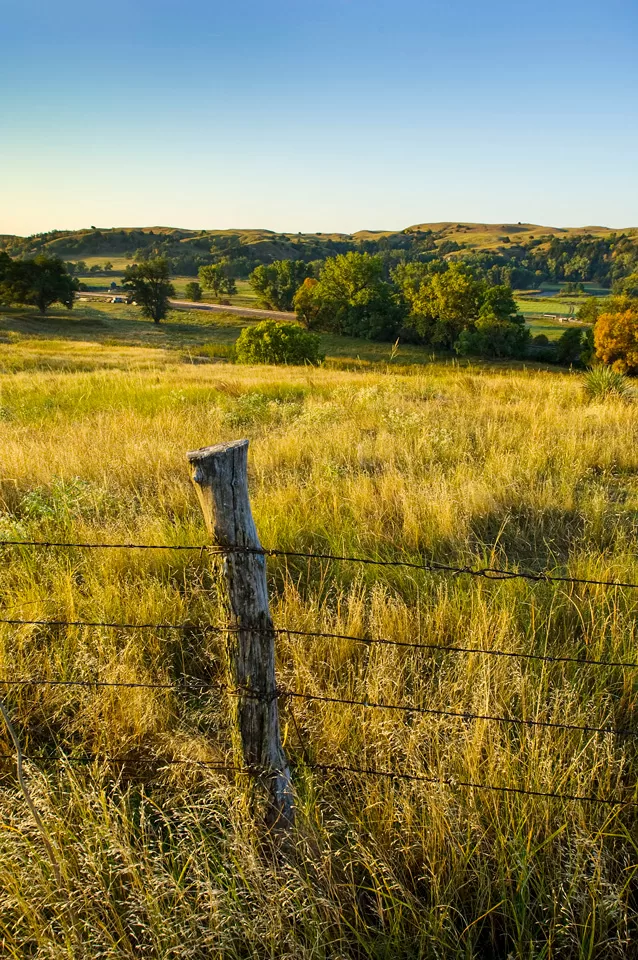
This popular route through the heart of the state’s Sandhills region provides many opportunities to experience the beauty of the prairie.
By Dorothy Rieke
May 2024
Nebraska’s Highway 2 is an artery of commerce as well as a scenic route that provides stunning vistas of one of America’s most unusual land formations, the Sandhills dunes in the north-central part of the state. Tourists headed for Yellowstone National Park or the Black Hills often travel this highway and, in doing so, discover some of Nebraska’s best-kept secrets. These include treasures of historical value, in addition to views of unique and beautiful ranches and small towns. In fact, many people consider the roadside scenes along Highway 2 to be among the most beautiful in the United States. Known as the Sandhills Journey National Scenic Byway, Nebraska Highway 2 stretches 272 miles northwest from the city of Grand Island to the city of Alliance.
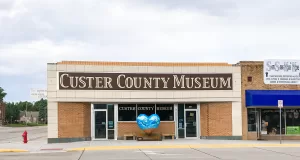
The Custer County Museum provides insight into the lives of residents from the pioneer days to today.
Highway 2 presents a daily panoramic view of farm buildings and uniquely designed farmhouses surrounded by grass-green yards and enhanced with flowers and bushes. The older homes demonstrate the needs of those who lived in them long ago. Many have porches where farm wives sat and broke beans or shelled peas in the cool outdoors. Smaller windows contributed to comfort inside on cold winter days. Large barns accommodated cattle and horses. Some buildings were for hay storage; others were used to house poultry and hogs or for fuel storage.
Many yards feature recently built homes. One-story ranch-style houses with large windows and smaller porches are popular today, with telephone and electricity lines strung toward them. Utility buildings tell the story of farming methods that use modern machinery.
Traveling this road, tourists also have an opportunity to learn about early-settlement days. Many of the population centers offer a slice of history in the form of museums filled with all the trappings of pioneer life.
For example, Broken Bow has the Boneyard Creation Museum and the Custer County Museum. The Boneyard Creation Museum is a science museum that contrasts evolution and creationism, with displays of fossils, replica fossils, and dinosaur models. Nearby, the Custer County Museum focuses on the daily activities of residents from the 1880s up to the early 20th century. The front room houses a re-creation of the Wescott, Gibbons, and Bragg General Store. The Solomon D. Butcher collection features the works of this itinerant Nebraska photographer who over the course of 40 years produced a photographic record of the settlement of the Great Plains.
Located in a restored 1920s red barn in Broken Bow, the Sandhills Journey National Scenic Byway Visitor Center showcases the beauty of the Nebraska Sandhills and activities in Custer County, Nebraska. The upstairs is full of neat historical facts about the Sandhills, an area rich in history. One visitor stated that the place was “amazing, especially with the replica sod house.‚
Leaving Broken Bow, an observant traveler would quickly notice a change in the landscape. Flatland crop fields give way to grassy rolling hills and valleys often dotted with clear-water ponds and well-fed cattle. Here’s the beginning of the Sandhills, an immense area measuring approximately 20,000 square miles. These hills represent the largest remaining tract of midgrass and tallgrass prairie in North America and are noted for having some of the most productive, fertile farmland in Nebraska.
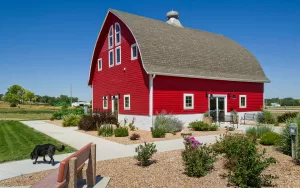
The Sandhills Journey National Scenic Byway Visitor Center is housed in a renovated 1920s barn.
During past years, receding water exposed an inland seabed west of what is now the state of Nebraska. The resulting sand dunes became known as the Sandhills. Indiangrass, big and little bluestem, prairie sandreed, and sand lovegrass later grew on the dunes and in the meadows. These grasses protected the underlying sand and gave a degree of stability to the dunes. Spring rains formed lakes, causing the water table to rise and flood the lowlands. In some areas, the water table rose to within a few feet of the surface, providing a sort of natural irrigation. Of course, the sub-irrigated meadows supported the heaviest growth of vegetation.
During the early years of exploration, the Sandhills were regarded as a dangerous region. Many stories were told of hunters and pioneers who got lost among these hills. Human skeletons have been found, telling the tale of those who fought a losing battle with hunger and thirst in a treacherous area with no fences and no roads. For many years, most people avoided this unusual, mysterious land. However, the Native American Sioux tribe had no concerns about this area, because they spent time hunting buffalo in these hills until the 1870s. Today, this area meets the needs of those who live there by supplying nutritious grass, water, and shelter for their cattle. Also, many ranchers have turned these hills into cropland, especially for growing corn.
The approximately 1,700-acre Pressey Park State Wildlife Management Area near Oconto, 16 miles south of Highway 2, offers a very special scenic setting for wildlife inhabitants. Years ago, English immigrant schoolteacher H.E. Pressey planted 60 varieties of trees on his homestead. Later, he deeded this land of tall trees and brightly colored wildflowers to the state to be used as a recreational park. Today, travelers stop to camp and spend their time strolling along the South Loup River. This river offers great fishing for carp, catfish, and bass. Picnic tables, a shelter, and grills are available for those who want to pause and reflect on the beauty of this place.
Another nice campground is found at the Victoria Springs State Recreation Area, located seven miles north of Merna. This park is situated on the site of an early settlement called New Helena. In the early 1870s, Charles Mathews, a settler from Virginia, made his home in this lowland oasis where mineral springs supplied water for a small lake as well as for the growth of trees and grass.
Mineral springs were seen as a way to gain better health, and the water from Victoria Springs was so popular that Mathews bottled it and sold it. He was, indeed, trying to increase his income as well as encourage pioneers to settle in the vicinity. However, his town did not prosper.
Visitors to this lovely recreational area can view Mathews’ log cabin residence as well as the log structure he built for a post office. Mathews became the first postmaster in Custer County and also served as a judge for a few years. An early one-room schoolhouse is on site also. This park is great for those who want to fish in the lake for largemouth bass, catfish, bluegill, and rainbow trout. The younger set can find many activities to enjoy in this recreational area, among them paddleboat rentals, a picnic area, and a playground.
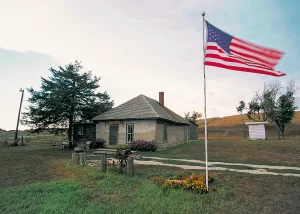
The Dowse Sod House is an example of construction once popular in Nebraska.
Victoria Creek emerged northwest of where the village of Anselmo is today. This body of water flowed a few miles southeast, turned to the northeast, meandered past a lagoon, turned again, and was joined by a dry creek that drained to the southwest. The stream then continued on to the southeast. Many different animals called this area home. Various species of waterfowl nested around the lagoon, and prairie chickens and grouse inhabited the hills. Buffalos could often be seen in wallows, natural depressions in a prairie that hold water, to keep insects off of themselves. Elk, deer, and antelope fed on the grasses. Amazing but true, there was only one tree visible in this valley, a big willow that grew along the bank out of reach of the animals.
In the 1870s, large herds of cattle were brought into this area. It was estimated that 20,000 head of cattle once grazed in the hills around this creek. The first settlers came to this valley in 1879, and most of the land had been claimed in just a few years.
Another glimpse of history can be found at the William R. Dowse House, also known as the Dowse Sod House, located about 10 miles outside of Comstock. It was built in 1900 and occupied until 1959. It is an excellent example of a sod house that was much better than others built prior. Sod houses were constructed from materials found on the prairie. To build a sod house, bricks made of earth were laid in a staggered pattern up to the desired height. The prairie grass roots system in the dirt held the bricks together. The choice of roofing depended on what was available in the area. Instead of a sod roof, the Dowse house has a pitched-wood shingle roof. Although its interior walls are made of plaster, many early sod houses had dried-mud walls. All in all, this house is likely one of the best surviving examples of a pioneer sod home.
Abundant wildlife in areas often dictates activities. So it is with the Nebraska One Box Pheasant Hunt, which takes place in Broken Bow every fall. This particular event, initiated by Tom Varney in 1961, promotes sportsmanship and hunting. The hunt includes five-member teams together with two guides, a judge, bird dogs, and a dog handler. The judge scores the number of shots fired against the number of kills. Each team is given one box of 25 shotgun shells. The hunt begins at sunrise and ends at 4:00 p.m. Of course, the team that brings in the most pheasants with the most remaining shells is the winner. In addition to the actual hunt, there are trap shoots, a victory banquet, and a reception. The event attracts people from around the world.
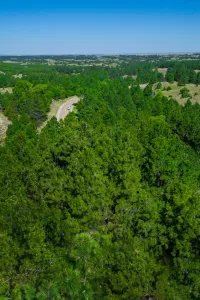
Near Halsey, the 222-square-mile Nebraska National Forest boasts the largest hand-planted forest in the western hemisphere.
Broken Bow is home to five parks. Among them is Melham Park, which boasts a five-acre fishing lake. Amenities include an Olympic-size heated pool, a picnic shelter, restrooms, a bike path, lighted softball and baseball fields, tennis courts, a playground, showers, restrooms, and a walking trail. This park is located at Fifth Street and Memorial Drive. Nearby Tomahawk Park, one block north of the intersection of Highway 2 and 15th Street, offers RV campsites with full hookups in addition to other recreational facilities.
Another interesting place to visit along Highway 2 is Nebraska National Forest at Halsey. The forest has two main parts: the one near Halsey and another west of Chadron. While the two areas differ, both offer many recreational opportunities; the one near Halsey was on our route. This beautiful forest was hand-planted and has hiking trails, a shallow and fast-moving stream, a fishing pond, a baseball/softball field, a basketball court, day-use pavilions, and hot showers. In addition, the Bessey Recreation Complex and Campground offers large campsites, with electric and nonelectric sites. Potable water is available for free, and there is also a dump station.
RVers searching for busy streets, traffic, Broadway shows, and other big-city amenities will not discover them on Highway 2. Instead, they will be greeted by world-class natural wonders, one million migrating sandhill cranes, and reminders of pioneer days in Nebraska. This scenic byway truly treats travelers to a slice of roadside Americana.
MORE INFORMATION
Sandhills Journey National Scenic Byway
sandhillsjourney.com
(308) 872-8331 (Broken Bow)