
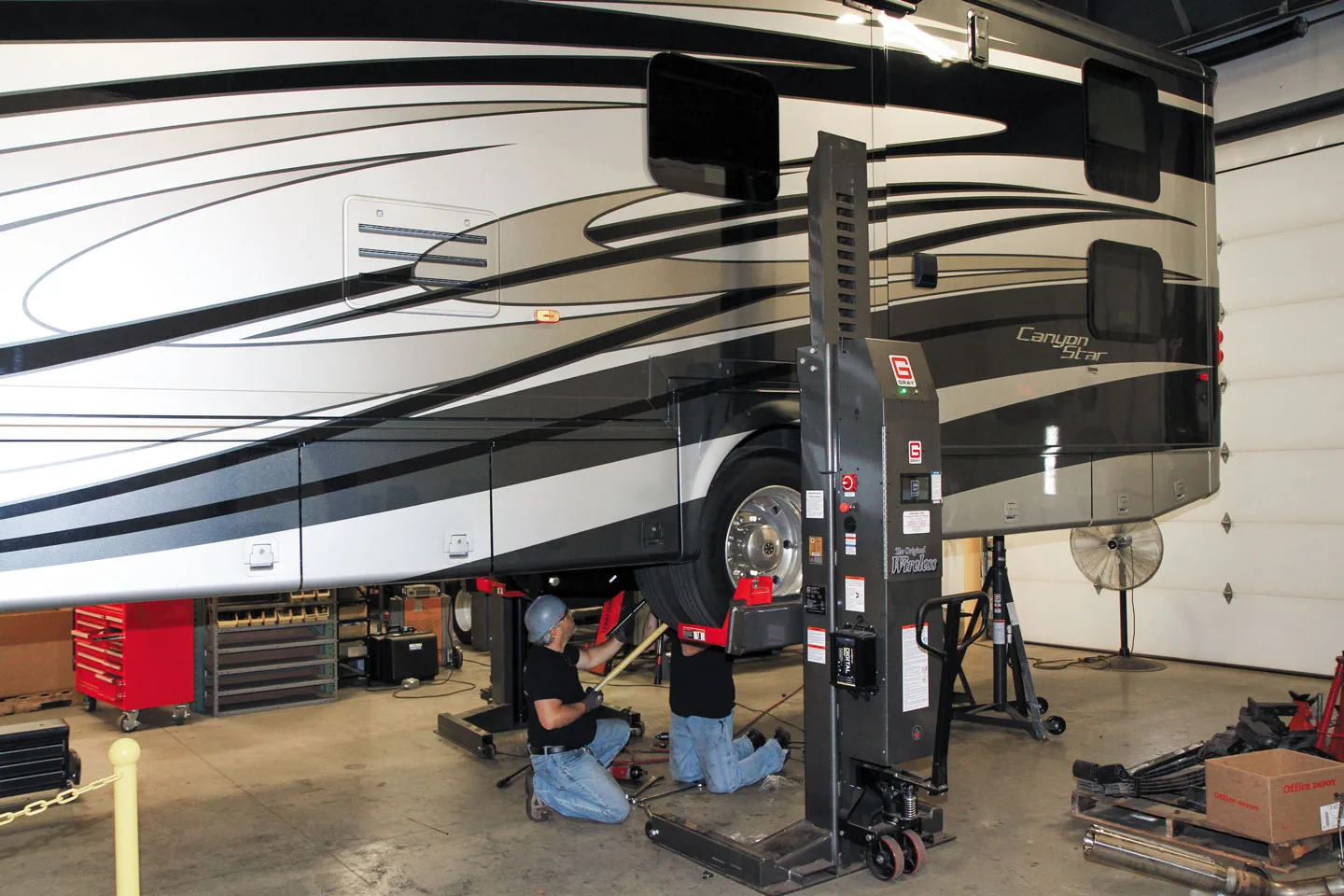
Explore solutions for enhancing the drivability of your home on wheels.
By Mark Quasius, F333630
July/August 2024
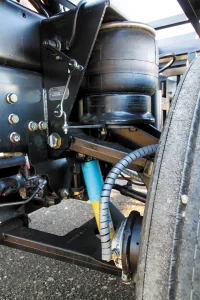
A portion of the front suspension on the author’s motorhome, which shows the air spring, control arms, Bilstein shock absorber, and ride-height control valve.
RVs make it possible to bring along the comforts of home as you travel, and the journey can be just as much fun as the destination. Of course, if you own a motorhome and dread the drive because of the way it handles, the trip won’t be very enjoyable, and you’ll be worn out from the day’s travel. Third-party suppliers offer a wide variety of components designed to improve motorhome handling. The secret is in knowing the shortcomings of your specific chassis and making the correct improvements. No one wants to throw money at components that aren’t necessary.
SUSPENSION TYPES
Several types of suspension systems exist — leaf spring, coil spring, air spring, hydraulic, and torsion bar. In addition, the LiquidSpring Smart Suspension is becoming more popular on Class A motorhomes.
Most gas-powered Class A motorhomes and diesel-powered Super C coaches currently utilize leaf-spring suspensions with solid I-beam-style front axles. Smaller Class C coaches generally are equipped with independent front suspensions that utilize coil springs. Most diesel-pusher motorhomes use air-ride suspensions that incorporate air springs, commonly referred to as air bags. Hydraulic suspensions, such as the LiquidSpring system, incorporate hydraulic cylinders and can be used to retrofit existing suspension systems, although some manufacturers offer LiquidSpring as an option on new motorhomes.
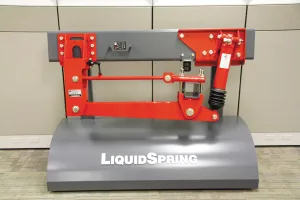
This model displays some of the LiquidSpring system.
Leaf springs are tried-and-true and have been around since the days of Conestoga wagons. The simple design provides weight-carrying capacity and also supports the axle, helping to hold it in place and to prevent it from shifting forward or backward beneath the vehicle’s frame. A leaf-spring bushing is fitted to the end of the leaf spring; a bolt through the bushing secures the spring to the spring shackle mounts.
Coil springs either mount above an axle or between a pair of control arms. Coil springs have no lateral control ability, so some sort of stabilizing device is required. On an independent front suspension, the control arms that contain the coil spring are mounted to the frame and prevent the axle from moving forward or backward. If the coil spring is located over a solid axle, such as the rear drive axle, a series of control links holds the axle in place.
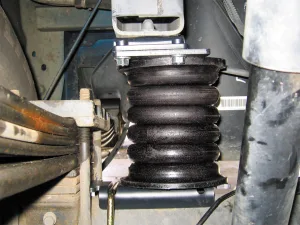
SumoSprings, shown here mounted next to a leaf spring, can enhance ride quality.
Air springs are similar to coil springs except an air bag is used instead of a steel coil. The air bag is pressurized by the coach’s on-board air system, and the amount of air is regulated by ride-height valves that keep the coach riding at the same correct height regardless of load conditions. As with coil springs, a series of control arms or links keeps the axle in place.
Today, torsion bar springs are not common on motorhomes, but they are popular on travel trailers.
FIRST CHECKS
If your motorhome is handling poorly, the first thing to consider is tire pressure. Readings should be taken when tires are cold, not after they have been driven or warmed by sunlight. The sidewall of every tire has an inflation pressure stamped on it to indicate the tire’s maximum load capacity. Unless the tire ends up being loaded to its maximum weight, it won’t be necessary to inflate it to the maximum pressure. To determine the proper inflation pressures, have your motorhome weighed on all four corners when it is fully loaded. Compare those readings to the inflation pressure tables found on tire manufacturers’ websites to determine the minimum inflation pressure needed to support the measured load.
Diesel pushers with air-ride suspension are equipped with automatic ride-height valves. A mechanical arm on the sensor or ride-height valve controls the amount of air that enters or exits an air spring. Each chassis has a specified ride height, measured between a given location on the suspension and a point on the chassis frame. Air is added to the bag when the coach is riding low, and excess air is bled when the motorhome is riding high. Handling can be adversely affected if the coach is not at the correct ride height. In that case, the rod attached to the arm must be adjusted.
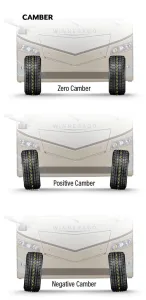
Camber
Next, have the alignment checked, including camber, caster, and toe-in. Camber is the tilt of a wheel when viewed from the front or rear of a vehicle. Caster is the angle of the steering axis when viewed from the side of the vehicle. Toe is the extent that tires turn inward or outward when viewed from above.
For Class A coaches, it also is important to check the thrust angle, which is an imaginary line drawn perpendicular to the rear axle’s centerline. It compares how the rear wheels are pointed in relation to the direction the coach is traveling. If the rear axle is at an angle, the rear end of the coach will tend to push off to one side. The driver then compensates by turning the steering wheel in the opposite direction, but this results in “dog tracking,” with the rear end offset from the front. You might think the thrust angle should be zero so that everything goes in a straight line, but some chassis specs call for a small amount of thrust angle to compensate for the crown in the road.
Thrust angle adjustments are made by shortening or lengthening the control rod on one side of the rear axle with air springs. Make sure your alignment facility is capable of checking thrust angle and has the correct specs for your chassis.
STEERING WHEEL FREE PLAY
When the driver moves the steering wheel back and forth but the vehicle doesn’t respond as it should, too much free play is involved. This can be caused by worn joints or loose connections in the steering mechanism. It’s best to have a professional service center do the inspections and checks.
ROAD WANDER
If you find it difficult to stay in your lane while driving because the coach wanders back and forth, even though you are holding the steering wheel steady, you are experiencing road wander. This can be caused by loose components, resulting in free play in the steering, but it also can occur even when free play in the steering is not an issue.
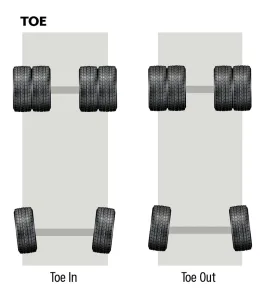
Toe
Class A motorhomes have a fair amount of rear overhang. Excessive weight beyond the rear axle means the front axle bears minimal weight, which can cause light steering. Shifting cargo from the rear to the front, or even adding weight to the coach, can help keep the front axle more firmly planted. However, take care not to exceed the rated capacity of either axle.
Coaches with front leaf springs tend to “walk” from side to side. This usually is related to the springs’ design rather than worn components. Leaf springs have a certain amount of flex in them because of their bushings and the way the shackle bolts are mounted. If your leaf-spring front axle is walking from side to side, front track bars can be added to help mitigate that problem.
But before attempting to correct a front-end issue, make sure you don’t have a “tail wagging the dog” situation.
TAIL WAGGING THE DOG
Many issues that appear to be related to the steering system are not caused by the front end of the coach but rather the rear. The tail-wagging-the-dog analogy applies here. As a small dog wags its large tail, the front of the dog wobbles. A motorhome might react in the same manner when sideways forces (from passing 18-wheelers, for example) are exerted on a large rear overhang. Once all that weight gets moving, it’s hard to stop it. Move the steering wheel back and forth and note that the motion at the rear of the coach affects the front end by moving it in the opposite direction. The coach tends to pivot on its vertical axis at the center of the rear axle. This is especially prevalent on coaches with a shorter wheelbase.
The laws of physics dictate that the front of the motorhome will move in response to lateral forces applied to the rear, but the factors that most affect handling are the length and weight of the coach, the axle configuration, and the type of suspension, as well as side winds and bow wakes from passing 18-wheelers.
As an 18-wheeler begins to pass on the left, a bow wake forces the rear of the motorhome to the right and the front end in the opposite direction. To stay in the proper lane, the motorhome driver compensates by steering to the right. Moments later, as the semi passes by the front of the coach, the bow wake presses against the front and the driver again compensates by steering in the opposite direction. This effect tends to be more noticeable on lighter motorhomes, units with shorter wheelbases, and those with leaf-spring suspensions.
As mentioned earlier, leaf springs allow quite a bit of flexibility when controlling lateral movement of the axle. The motorhome body moves laterally in response to pressure applied to the rear of the vehicle. This causes the leaf spring and mounting hardware to flex and allows the motorhome to move sideways in relationship to the axle, which stays in contact with the road. The sideways movement of the coach causes the front end to move in the opposite direction, requiring steering corrections by the driver. To prevent the lateral movement of the coach body in relationship to the rear axle, a Panhard rod, commonly referred to as a track bar, can be added.
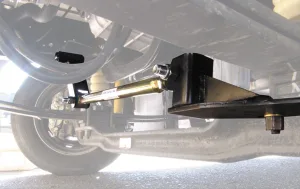
The Davis TruTrac front stabilizer bar supplied by Roadmaster helps to eliminate wandering and rut tracking.
A track bar is a long steel rod with attachment points at each end of either a rear axle or a solid I-beam front axle. One end of the rod mounts to a bracket on the coach frame on one side of the vehicle; the other end mounts to a bracket on the rear axle at the other side of the coach. This ties the coach body and axle together laterally so that the axle cannot walk out from under the coach. As the motorhome travels over bumps and dips, the track bar pivots to allow for unimpeded vertical movement of the coach body. Aftermarket suppliers offer track bars designed for specific Class A and Class C chassis equipped with leaf springs. Note that diesel pushers with air springs are already equipped with track bars because the air bags have no ability to locate the axle beneath the coach.
SWAY
Sway is the roll or lean of a motorhome in response to pressure exerted from the side. A suspension is designed to soak up bumps and dips encountered while driving. When traveling through a curve, the top of the motorhome tends to lean to the outside of the curve as the weight shifts, compressing the outer springs and decompressing those on the inside. Sway can also occur when a motorhome encounters heavy wind gusts or when negotiating a driveway ramp that pitches the coach from side to side.
An anti-sway bar (also referred to as a sway bar) strengthens the suspension. The middle of this large, horseshoe-shaped steel bar generally is attached to the frame rails, and each end of the bar is attached to the suspension members or axle ends via sway bar links. The horseshoe wants to remain flat, so if energy is applied to the left side of the coach, the left side of the anti-sway bar wants to twist upward, while the right side wants to twist downward. The anti-sway bar attempts to flatten itself out, returning the coach to a level position.
Anti-sway bars come in various diameters and corresponding strengths and should be sized for a particular vehicle. The heavier the vehicle, the larger the diameter of the bar. But if the anti-sway bar is too heavy for the vehicle, weight(and traction) will be removed from the inner wheel as the vehicle rounds a curve. On the other hand, a bar that allows excessive sway is not desirable, either. In that case, replacing the original bar with a larger one may be the answer. On an older coach with a fair amount of mileage, the anti-sway bar may have weakened and be in need of replacement.
On a motorhome with air springs, motion control units (MCUs) can be added to assist in managing sway. MCUs — compact cylinders that connect in the air line to each air bag — control the flow rate in and out of the bag via preset valves. They won’t replace an anti-sway bar but can be a cost-effective means of lessening sway.
PORPOISING
A porpoise swims by propelling its body up and down. A vehicle can experience similar oscillating action as first its front axle and then its rear axle encounters a bump. Porpoising is more prevalent in motorhomes with shorter wheelbases. A longer distance between the front and rear axles gives the suspension time to settle out between bumps. Most of the time, porpoising can be controlled by changing the shock absorbers, assuming the springs are in good shape.
Shock absorbers dampen the compression and extension of the suspension to prevent the axle from bouncing up and down indefinitely. A piston within a shock absorber moves inside a hydraulic-fluid-filled tube. As the piston moves, the fluid passes through orifices and valves that restrict the flow, controlling the resistance to suspension movement. The kinetic energy of the suspension movement is converted into heat.
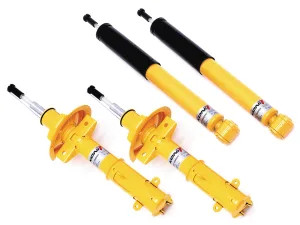
Adjustable high-quality shock absorbers such as these from Koni often can improve motorhome handling and ride quality.
Shock absorbers are velocity sensitive, so resistance increases as the suspension moves faster. Overly stiff shock absorbers will deliver a rougher ride, while overly soft shocks allow excessive movement and rebounds, such as in porpoising.
Gas-filled shock absorbers perform better than standard shock absorbers, although at a higher price. The fluid in the shock absorber can foam and aerate with use. Gas-filled shocks minimize this by adding a chamber of high-pressure compressed nitrogen beneath the hydraulic oil, separated by a floating piston to prevent the gas from mixing with the oil. As the dampener compresses, the oil is displaced and compresses the gas in the chamber. The gas then expands to its normal volume as the shock extends, ensuring that even the smallest movements are dampened.
Adjustable high-quality shocks, such as those made by Koni, allow the stiffness level to be set when the shock absorber is installed. Many owners set them at full stiffness and never bother to adjust them. Even so, Koni shocks often yield improved ride and handling. Koni’s premier shocks feature Frequency Selective Damping technology, which, company literature notes, aims to solve the suspension conflict between comfort and handling.
Many times, shock absorbers installed as original equipment are chosen because of price rather than performance. Installing a shock absorber with a large-diameter piston will improve performance. The increase in surface area results in lower internal pressure in the shock during operation, which reduces ride harshness and can add more control force when dampening.
RUT TRACKING
Rut tracking is the tendency of a vehicle to follow grooves in the road. The tires may shift the vehicle to one side of a ridge or break between two pavement types. The main causes of rut tracking are tires and front axle weight.
If the front axle of the motorhome doesn’t have enough weight on it, the front tires will not be firmly planted, which allows them to be pushed off to one side of the road quite easily by pavement variations. Typically, front-axle weight issues occur on shorter-wheelbase coaches or on longer single-rear-axle coaches with motorcycle carriers or high trailer tongue weights. The extra weight hanging behind the rear axle acts as a lever and removes weight from the front. Generally, the front axle should carry at least half as much weight as the rear axle. This refers to actual scale weights obtained with the vehicle fully loaded, not the axle ratings.
If the front axle is underweight, options may include adding weight to the front of the motorhome; re-moving weight from the rear; and rearranging cargo so that heavier items are in the front rather than the rear. In any case, never exceed the gross axle weight rating (GAWR) when adding or transferring weight.
Tires are another consideration. Tires designed for heavy trucks have heavy sidewalls, and when installed on an RV, these tires tend to follow ruts and deliver a harder ride. Tires designed specifically for RV use have softer sidewalls and flex enough to minimize rut tracking, offering a smoother ride.
Tire pressures also affect rut tracking. If you can safely reduce tire pressures a bit, you will see some improvement. However, make sure you have accurate four-corner weights and never reduce the tire pressures below the minimum recommended pressures for those weights as indicated in the tire manufacturer’s inflation tables.
Each of the handling issues described can be corrected once you’ve nailed down the cause. You may be able to remedy the situation yourself in some instances, or you may require the expertise of a chassis service and alignment center. Either way, the result should be a motorhome that is a joy to drive.
MORE INFO
MOTORHOME CHASSIS
Ford Motor Company
(800) 392-3673
ford.com
Freightliner Custom Chassis Corporation
(800) 385-4357
fcccrv.com
Spartan RV Chassis
(800) 543-4277
spartanrvchassis.com
SUSPENSION SYSTEMS/COMPONENTS
Bilstein
bilstein.com
(shock absorbers)
Koni Shocks
(859) 586-4100
www.koni-na.com
(shock absorbers)
LiquidSpring
(765) 474-7816
liquidspring.com
(suspension system)
Reyco-Granning
(800) 753-0050
reycogranning.com
(front and rear suspensions)
Roadmaster
(800) 669-9690
roadmasterinc.com
(anti-sway bars, TruTrac bars, steering stabilizers)
SuperSprings
(805) 745-5553
supersprings.com
(SumoSprings)
SuperSteer
(888) 898-3281
supersteerparts.com
(track bars, bell cranks, Safe-T-Plus, Bilstein and Koni shocks)