
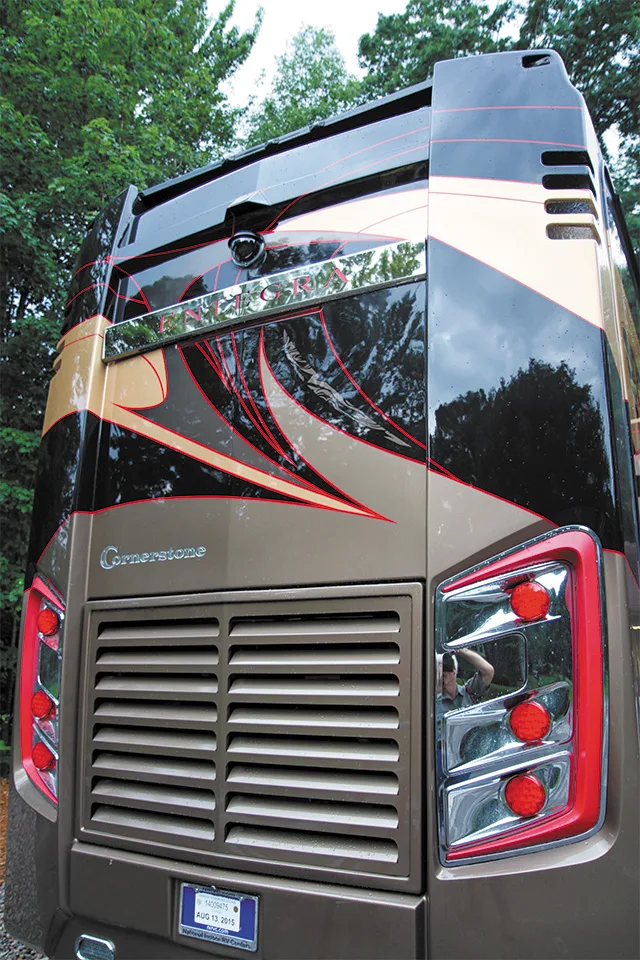
Rearview, side-view, and 360-degree RV cameras add a level of safety while driving.
By Mark Quasius, F333630
November/December 2024
The key to safety when driving an RV, or any large vehicle for that matter, is situational awareness. You need to remain alert and aware of your surroundings, and to be able to see where you are going. Rear vision is problematic for RV drivers. If you are towing an RV with a pickup truck, the rearview mirror on the windshield will be useless. Motorized RVs present the same challenge, and for the most part, they don’t even have interior rearview mirrors. A few are equipped with them to monitor the inside of the motorhome and its occupants while traveling.
Rear vision isn’t just important for backing up, either. When passing another vehicle on the road, you need to know whether you have enough clearance to safely duck back into the right lane. Side mirrors help, because they allow you to see the sides of your RV as well as what’s behind it. But side mirrors have blind spots, especially near the front of the RV. They also don’t allow for very good depth perception, so it’s hard to tell how far away an object is. The best option is to augment those mirrors with a camera mounted on the rear of the RV.
Rearview cameras have been around for quite some time. The earliest ones were better than nothing, but with significant advances in technology, today’s cameras are vastly improved and can produce some crisp, detailed images. Plus, prices are affordable. Most motorized RVs now come with some form of rearview camera, and many towable units come prepped for a wireless camera that can send video to a monitor in the truck connected to the RV. For those of us whose RVs are not equipped with a rearview camera, or those who would like to upgrade to a better-quality system, all is not lost. A number of available units can be installed by an owner or an RV dealer.
REARVIEW CAMERA FEATURES
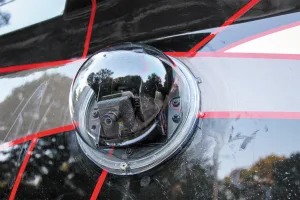
The Total Vision camera is enclosed in a clear dome.
When it comes to a rearview camera, the driver needs a view wide enough to yield a good field of vision behind the RV, but without that fishbowl effect that masks how far away objects are. Most rearview cameras designed for RVs range between 120 and 150 degrees of horizontal vision. Some models also include a grid-line overlay that helps to depict how far away an object is, although these grids are supplied by the camera manufacturer and impacted by where the camera is mounted as well as the angle at which it is placed, so they may not be overly accurate for your specific RV.
Many rearview cameras have a microphone that can send audio to a monitor equipped with speakers. This can help if you want to hear spoken directions from a partner acting as a spotter, but it tends to be useless on a diesel pusher because of the engine noise at the rear of the coach. Plus, it’s one-way communication, so the driver can’t talk to the spotter. I prefer to use small two-way radios or hand signals instead, so not having this feature is not a deal breaker for me. Many RVers use cellphones for this purpose.
Night vision on rearview cameras also has improved quite a bit. The latest models use infrared technology that can capture clear images at up to 30 feet at zero lux (low light level intensity). This is a plus when driving at night, and as long as the camera’s contrast ratio is fairly high, you shouldn’t experience blooming from headlights approaching closely from behind.
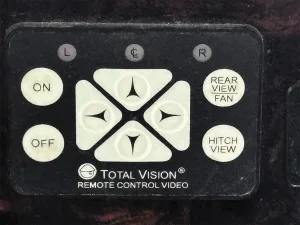
A control pad on the dash makes it possible to pan left or right with the Total Vision camera or tilt it vertically.
Some cameras allow views comparable to looking at a normal rearview mirror, and some offer a hitch view to look downward at the immediate rear of the RV. This can be helpful for viewing the hitch when hooking up, but it’s also useful when backing into a campsite where you need to be aware of just how far you can go without hitting something or running off the pavement.
My personal choice for our 2016 Entegra Coach was a Total Vision camera, to replace the original-equipment unit I didn’t care for. The Total Vision camera uses a Sony 1/3-inch-type charged-coupled device (CCD) color camera that provides nice, bright, crisp images. What is unusual is that it is placed inside a clear dome on the rear of the coach. The camera is motorized, so I can pan it left or right for a full 180-degree horizontal swing, as well as a 115-degree vertical tilt. This is all handled by a small control pad on the dash. The panel also can be used to turn on a small fan inside the dome to remove fogging, which rarely is necessary. It has two settings — one for rear view and one for hitch view. Tap a button and the camera moves to those preprogrammed positions, although I can still tweak them manually within the entire range of movement.
SIDE CAMERAS
Side camera systems are included as standard equipment on some new RVs. These cameras mount in pods attached to the front sides of the RV or to the side mirrors on a motorhome. The monitor is connected to the turn signal wires, and the appropriate side camera’s view replaces the rear camera image on the monitor whenever the turn signal is active. They sound like a great idea, but on larger motorhomes, blind spots still exist near the front of the coach, and the tunnel vision and lack of depth perception they produce makes it hard to determine if the vehicle in the image is next to the RV or behind it. Also, while the turn signal is active, you lose your rear camera view, so it’s harder to determine if it’s safe to move back into the right lane after passing a slower vehicle. It’s still hard to beat a good set of mirrors combined with a rearview camera. Unless you have a 360-degree camera system, that is.
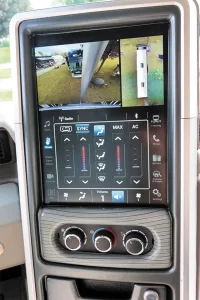
A display on the author’s coach shows the 360-degree and rear views, plus a touch screen for multiplex system controls.
360-DEGREE CAMERA SYSTEM
The 360-degree camera systems are the latest and greatest advancement in technology for motorhomes. Imagine, if you will, a drone flying directly over your RV that follows you wherever you go. It has a camera that looks down on the RV and sends that video feed to a monitor inside. You will be able to see the RV and everything immediately surrounding it. No more blind spots. You’ll know exactly where the car alongside you is, and you’ll know what is behind you. This is helpful not only when driving but also when backing into a campsite to help avoid hitting pedestals or picnic tables or any children who might wander into the immediate area.
These systems utilize multiple cameras mounted near the top of the sides, front, and back of the vehicle. Each image goes through a central processing unit that stitches them together to produce a bird’s-eye view. The images then are wrapped around a generic image of the roof of a motorhome, which would be higher than the cameras themselves. The result is a perfect real-time satellite-type view (except for the generic roof) of your RV and its surroundings. These systems require a bit of cable to be run through the walls, so an installation would be difficult as a DIY project. The cameras also need to be placed at precise heights and locations, which are determined by computer software. And the cameras must be calibrated by viewing some special targets placed on the floor, so this really needs to be an original-equipment manufacturer or professional installation by specialists.
A 360-degree camera eliminates the need for side cameras, but some of the OEM systems are set up to override the rearview monitor when a turn signal is activated. Ideally, the 360 vision should be on a separate monitor that does not interfere with the rear camera monitor, or at least on a split screen with a large enough monitor.
ADDING OR UPGRADING
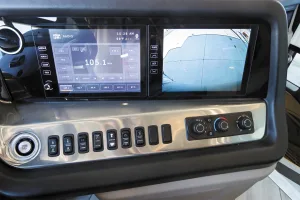
With this dual monitor system, the rear camera displays on the right screen; the left screen can be used for GPS navigation, entertainment center controls, or side cameras.
With the exception of the 360-vision camera systems, adding or replacing a rearview camera system isn’t a difficult DIY project. Wiring is the biggest task. If you want to incorporate side cameras on a motorhome, you will need to tap into the turn signal wiring under the dash to connect to the monitor or a control box that switches between the rear cameras and any side cameras. If you are adding a new camera, you will need to run a cable between the camera and the monitor.
Keep in mind that there are a fair amount of up and down detours when running this cable, so be sure to purchase a long enough cable. For example, the 65-foot cable I used to install the Total Vision camera in my 45-foot motorhome was just long enough. If replacing an existing camera, you’ll have to research what kind of cable it currently has and compare it to what the new camera requires. You may be able to utilize the original cable and save yourself some work. But cables come in different configurations, so you may or may not be lucky enough. Some manufacturers offer direct replacements for original-equipment cameras, and finding one that meets that criteria will simplify the process.
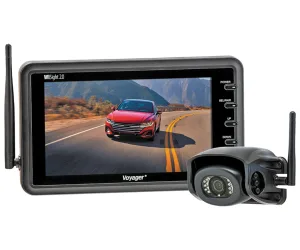
The Voyager WVSXP70 wireless camera system comes with a 7-inch LCD monitor, a 12-volt accessory plug, and a suction-cup monitor mount.
Many wireless cameras are now available at surprisingly low costs. The hardest part might be finding specifications on the camera as to how good its resolution, contrast ratio, and angle of view are. Amazon is one source for these inexpensive cameras, and many of them are imported from China. Some have some pretty good reviews, and one might have to rely on those reviews rather than specifications when choosing a camera system.
Wireless cameras are perfect for towable RVs, because direct cabling would be more complicated with two separate vehicles. These cameras can be a good choice for a motorhome as well, to avoid taking everything apart to run wiring between the camera and monitor. All that’s really required is to provide a 12-volt power source for the camera.
Many towable RVs come equipped with a standard port ready to mount and connect a Furrion-brand wireless camera. But if a dedicated power supply is not provided, you can always tap into the rear marker light circuit. That will power the camera, but you must have the marker lights on when driving or the camera won’t work. The monitors generally plug into a standard 12-volt power socket on the towing vehicle and often come with suction cup-mounts.
With so many good options available today, RV owners shouldn’t have any issue finding a camera setup that will meet their needs and add to their safety while navigating the highways and byways.
SUPPLIERS
Following is a list of several popular systems used in recreational vehicles:
Furrion
Wireless camera system commonly used by OEMs and RV owners.
(432) 547-7378
furrion.com
Rear View Safety
Numerous wired and wireless systems, including the Inview 360° camera system.
(800) 764-1028
rearviewsafety.com
RV Cams
Dealer for numerous brands of RV camera systems and provider of parts and service for many brands, both current and discontinued, among them Sony, Voyager, Mito, and TripleVision. Custom packages are available, such as the 70-CHNV, priced at $395.
(225) 261-9946
rvcams.com
Total Vision Products
Numerous systems, including the motorized dome camera.
(520) 623-0790
totalvisionproducts.com