
Along the Bay of Fundy, travelers can glean insights into Canada’s cultural heritage by exploring national parks and other attractions.
By Josephine Matyas, F468364
May/June 2025
In the Annapolis Valley — the ribbon of land along the Bay of Fundy coastline in the western part of the Nova Scotia peninsula — Canada’s history is baked into the landscape. This is evidenced in the original French cannons that once guarded fur trading routes; in the forts where men learned to survive harsh northern winters; and in the deep sentiments about the tragic Acadian deportation that tore families and communities apart.
Few places weave together the story of Canada’s pre-Confederation days with such pride, color, and panache.
The rolling farmland, villages, and views over the famous Bay of Fundy from Annapolis Royal to Grand-Pré are an RVer’s dream. The short driving route is peppered with Parks Canada national historic sites, small wineries and cideries, farm stands, and top-notch campgrounds. It’s a drive where leisurely hopscotching is the name of the game.
It makes sense to start at the beginning.
PORT-ROYAL
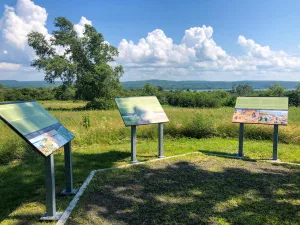
At Melanson Settlement National Historic Site, a loop trail reveals the vista enjoyed by the Acadians of the 1700s.
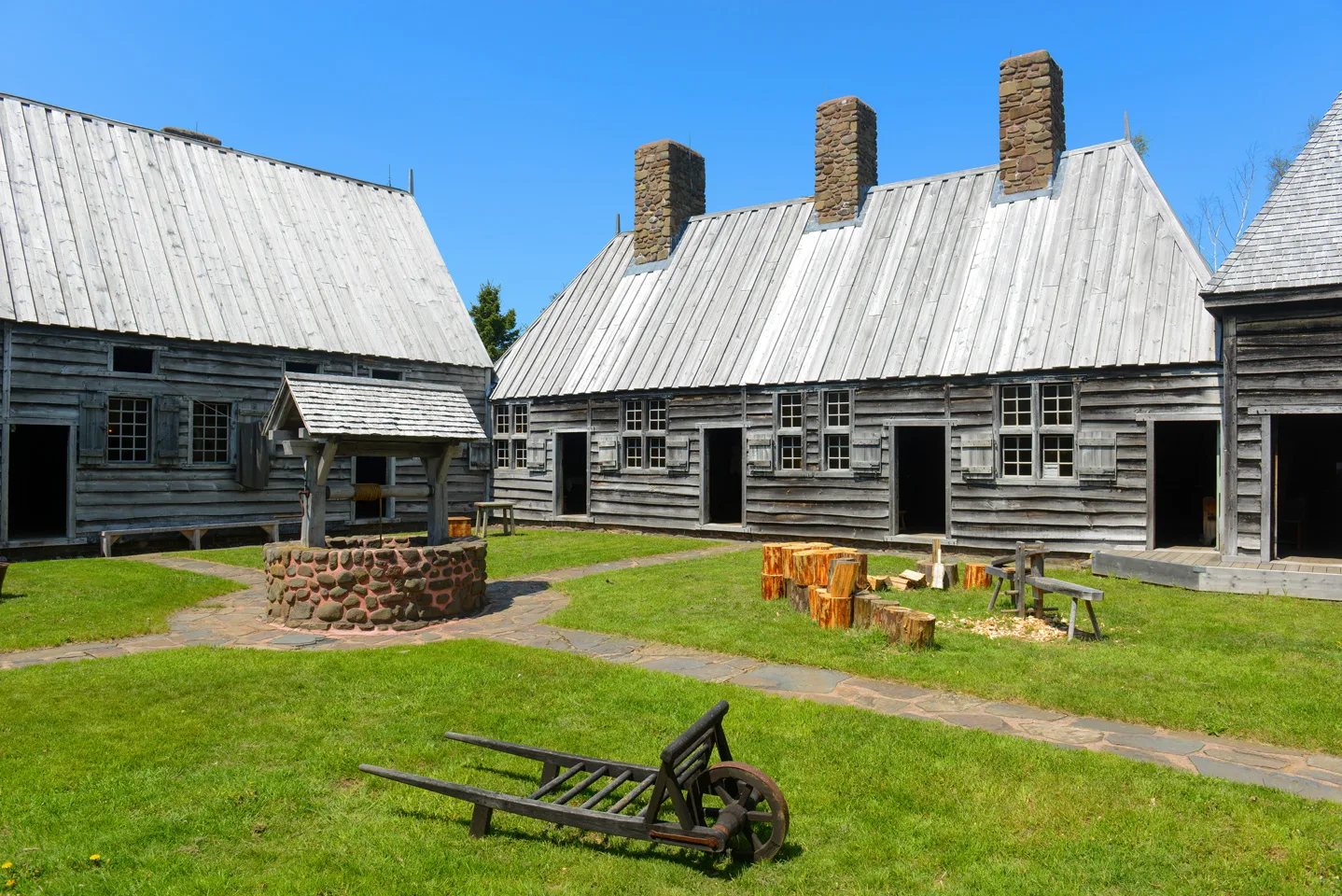
The French explorer and map-maker Samuel de Champlain arrived at Port-Royal — now a national historic site — in 1605, but the story became momentous with the destruction of the Habitation in 1613 by an English raiding party from Virginia.
“Between 25 and 40 men lived here at one time,” explained Paul Lalonde, the site’s supervisor of interpretation. “It’s a very significant period, because this is where the French achieved something no other European explorers had. They overwintered and survived. . . . and that is the big story here at Port Royal.”
Lalonde credits that success to the explorers’ relationship with the First Nation Mi’kmaq, who knew the ways to survive the bitter, cold winters. “Many a meal was shared at the fort, and the French developed an important alliance with the Mi’kmaq,” he said.
The French explorers chose Port-Royal because of the deep waters of the Annapolis Basin — a good port that easily could be defended, and a central location for commerce and trade.
Visitors can tour the Port-Royal Habitation, a replica of one of the earliest 17th-century European settlements in North America. The rectangular formation of hand-hewn wooden buildings centered around a courtyard includes the forge, trading room, kitchen, common rooms, and sleeping quarters for the men.
“The fur trading area is the most important part of the Habitation,” Lalonde said. “The beaver pelt was the main item the French were after; they were used to make the felt hats so in style in Europe.”
The Mi’kmaq would bring beaver, otter, and moose skins to trade for metal objects such as copper and iron pots, iron axes, and knives.
A brief drive down the road from Port-Royal leads to the Melanson Settlement National Historic Site, featuring a short walking loop that shows the exact views over the marshlands and fields that were the Melanson family farmlands. There are no buildings and no admission fee. It’s a quiet spot to stretch your legs and reflect on the life of 17th- and 18th-century Acadian families.
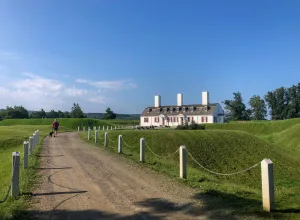
The officers’ quarters at Fort Anne National Historic Site.
FORT ANNE AND ANNAPOLIS ROYAL
Annapolis Royal, a small town of approximately 530 residents, boasts one of Canada’s largest national historic districts, with 135 registered properties. You could stand almost anywhere in the small village, toss a stone, and hit a home or business brimming with Canada’s early history. But it’s the commanding officers’ quarters, stone powder magazines, and 18th-century earthwork fortifications of Fort Anne National Historic Site that draw thousands of visitors each year. The historic site is stretched out along the village’s main street.
Fort Anne has a complicated history. Its ownership flipped back and forth as the Scottish, French, and English settlers battled over its prime strategic location at the confluence of two rivers. The well-fortified site was considered the key to domination of this part of what would become eastern Canada. Fort Anne played an important role in the 17th- and 18th-century struggles for the empire.
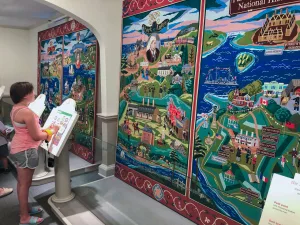
Inside the officers’ quarters, a beautifully detailed tapestry tells the stories of Annapolis Royal.
Fort Anne was originally built to secure the overland route between Annapolis Royal and Halifax, and the small piece of land was also a seed for the development of the Acadian culture. After a few generations, the settlers from France would have considered themselves Acadians, no longer French. Over time, new Acadian settlements moved up the river to spots such as Grand-Pré.
According to site interpreter Lukas Clark, “The Acadian identity grew after two or three generations. After many clashes between the French and English, the people who lived here wanted to stay out of the conflicts. From 1710 onwards, the British ruled the fort and, at the start, were tolerant of those they called the French neutrals.”
He went on to explain, “As time passed, the British demanded the Acadians swear an oath of allegiance — including taking up arms against the French — to which the Acadians refused. The British felt the Acadians could not be trusted, leading to the expulsion order of 1755, a sad story that is told in full at the Grand-Pré [National Historic Site].”
Fort Anne visitors can explore the grounds, the military building, and the museum on their own or take one of several guided tours that explain why this spot is considered “The Cradle of Acadia.” They can walk through the Vauban Fortifications, a star-shaped earthwork layout built by the French in the early 1700s. Inside the old officers’ quarters (the large, picturesque white building), the Fort Anne Heritage Tapestry, which measures 8 feet high by 18 feet wide, depicts four centuries of history through three million tiny stitches in 95 shades of wool. In addition, Mi’kmaq art celebrates the rich history of Annapolis Royal.
“Right next door is the Garrison Graveyard with Canada’s oldest inscribed English gravestone, dating back to 1720,” interpreter Clark said. British soldiers and their families are interred there. “Ground-penetrating radar confirms several hundred unmarked graves, most likely those of Acadian settlers whose wooden crosses would have rotted away with time,” he added.
UPRIVER TO GRAND-PRE
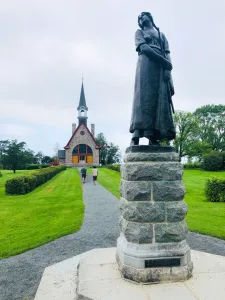
Near the Memorial Church at Grand-Pré stands a statue of Evangeline, heroine of Longfellow’s epic poem.
Travelers have two ways to make the 70-mile trip from Annapolis Royal to Grand-Pré: along the quicker Highway 101 (the Harvest Highway) or along the slower Highway 1 (The Evangeline Trail), the latter passing through towns like Berwick — Nova Scotia’s “Apple Capital” — and perhaps a stop at Spurr Brothers for local cider. Both are scenic, easy drives with any size RV.
The Evangeline Trail is named after the mythic character in Henry Wadsworth Longfellow’s poem Evangeline: A Tale of Acadie, the beloved literary work that tells the story of the Acadian people and the Deportation of 1755 to 1762. Acadie was a territory originally settled as a colony of New France. Today, Grand-Pré is a national historic site as well as a UNESCO World Heritage Site.
“The Acadian settlements would have moved here to Grand-Pré in the early 1680s,” said Abbie Targett, a student interpreter at the site. “After they refused the British demands to sign an allegiance to bear arms against the French, they were rounded up — their homes burned to the ground — loaded onto ships, and deported to colonies along the Eastern Seaboard. Almost half the Acadians escaped the deportations and moved inland to places like New Brunswick and Quebec.”
While the Deportation is the main focus at the site, the museum and the surrounding landscape show the story of how the industrious Acadians implemented a system of diking and desalination to reclaim the salty tidal marshlands and turn them into soil so rich and fertile that it was known as “the breadbasket of Acadie.”
“All the farming that happened here was because of those dikes,” Targett explained as she pointed out the hollowed-log dike replicas inside the museum. The intertidal area experiences the world-famous Fundy high tides; the land reclamation practiced by the Acadians (and still in use today) employed dikes, wooden sluices, and a drainage network to allow fresh water to flush most of the salt from the system.
The large parking lot at the Old Post Road overlook makes for an easy drive-through for RVs, with a beautiful view of the landscape, the dike wall, and the fertile fields.
MORE TO EXPLORE
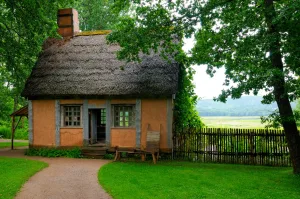
A 17th-century Acadian house replica can be viewed at Annapolis Royal Historic Gardens.
Although the drive along the Annapolis Valley from Annapolis Royal to Grand-Pré is short, the route easily could be spread over four or five days. Just 72 miles long, the journey spans 400 years of settlement, rich in culture, diversity, history, and natural beauty.
In addition to exploring the national historic sites, it is worth taking time to stroll through the Annapolis Royal Historic Gardens, which showcase local history via gardening methods and designs; dig into a seafood dinner at Hall’s Harbour Lobster Pound and Restaurant; and explore downtown Wolfville’s quaint restaurants.
CAMPING ALONG THE WAY
Upper Clements Park Cottages and RV Park (upperclementscottages.com) is a pet-friendly facility with 33 campsites just five minutes from the town of Annapolis Royal. Features include property-wide Wi-Fi, free-roaming bunnies, a laundromat, and an in-ground pool. No shower facilities are available.
Land of Evangeline Camping Resort (evangelinecampground.wordpress.com) near Grand-Pré has 83 pet-friendly overnight sites (mixed with seasonal sites). Amenities include pay showers, laundry facilities, a pool, internet access, and a small store.
We mixed up our travel experience with a stay at the Grand-Pré Parks Canada oTENTiks (parks.canada.ca/lhn-nhs/ns/grandpre/activ/otentik). A cross between a tent and a rustic cabin, the eight oTENTiks are a short walk from the parking lot. Electricity is not provided, and food preparation is only allowed outside on the veranda. Dishwashing stations and showers are available for overnight guests.
MORE INFO
Annapolis Valley Tourism
valleytourism.ca
Parks Canada
parks.canada.ca
Tourism Nova Scotia
novascotia.com